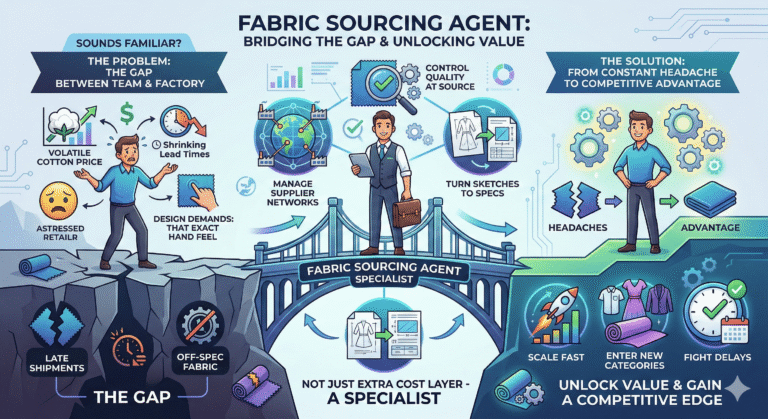
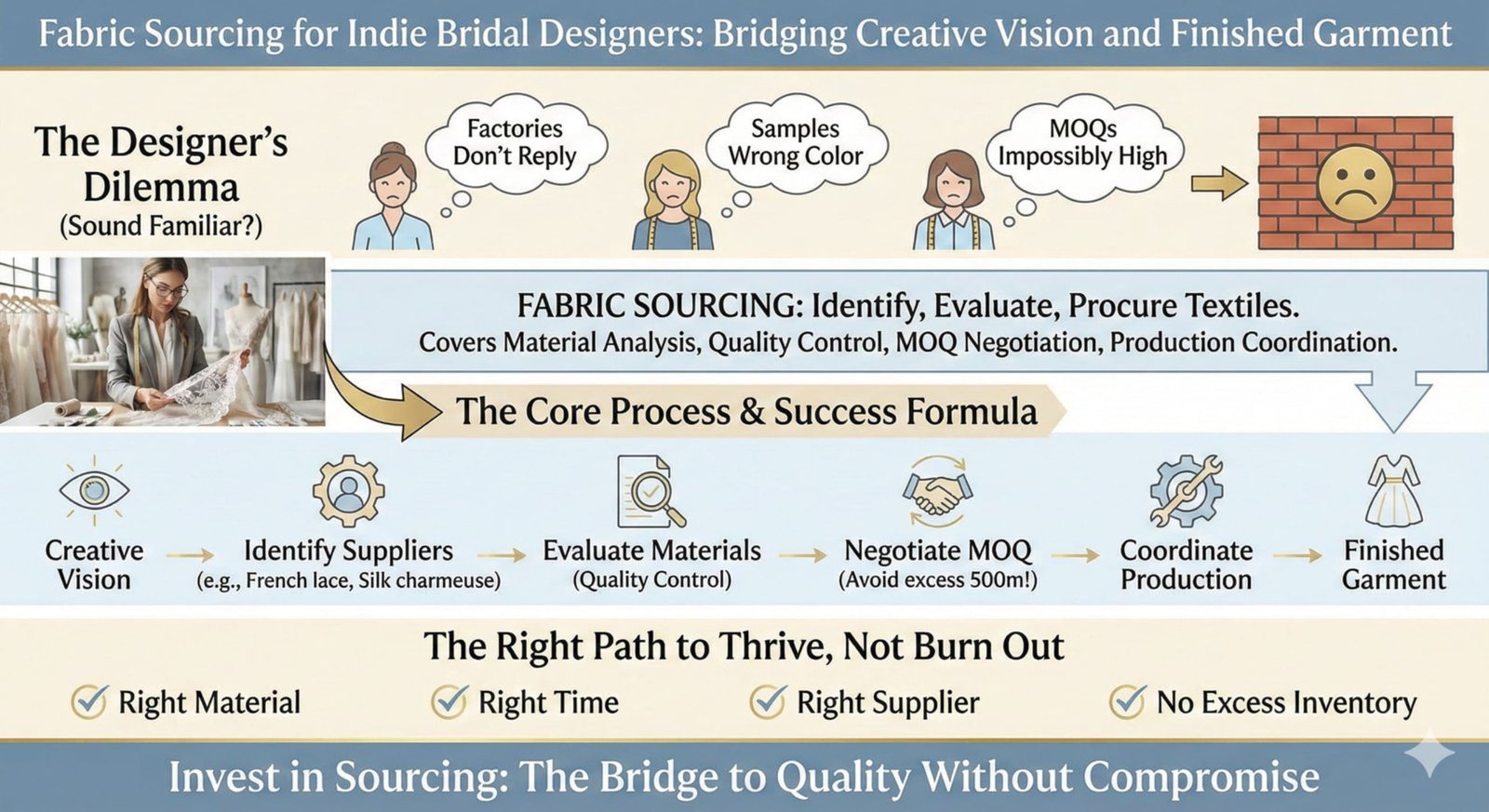
You've got the design sketches ready. Your brand identity is clear. But when you start searching for that perfect French lace or silk charmeuse, you hit a wall.
Factories don't reply. Samples arrive in the wrong color. MOQs are impossibly high.
Sound familiar? 😰
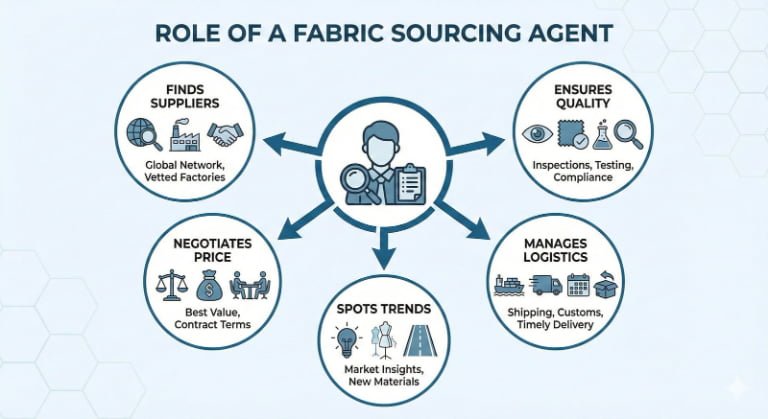
Fabric sourcing is the end-to-end process of identifying, evaluating, and managing fabric supply—covering material analysis, quality control, MOQ negotiation, and production coordination. For indie bridal designers, it's the bridge between your creative vision and a finished garment that doesn't compromise on quality, cost, or delivery time.
I've been doing this for over 20 years in China's bridal supply chain, and I can tell you: fabric sourcing is where most small brands either thrive or burn out.
It's not just about finding cheap material.
It's about finding the right material, at the right time, from the right supplier—without getting stuck with 500 meters you don't need.
📌 Key Takeaways:
• Professional fabric sourcing requires deep material expertise, strong supplier networks, and process-driven quality control
• Success depends on analyzing fabric composition, replicating samples, and coordinating with mills and dye houses
• Effective sourcing balances MOQ negotiation, inventory planning, and contract-based lead-time management
- What Is Fabric Sourcing? Definition and Scope 🎯
- Why Professional Fabric Knowledge Is Your Foundation 📚
- How to Build the Right Supplier Base 🏭
- Why Quality Process Management Cannot Be Ignored 🔬
- How Do You Control Lead Time Through Contracts? ⏰
- What Role Does Supplier Performance Play? 📊
- Frequently Asked Questions ❓
- Conclusion 🎉
- Ready to Elevate Your Bridal Sourcing? 💍
What Is Fabric Sourcing? Definition and Scope 🎯
Fabric sourcing is the professional practice of securing the right fabrics for your products—at the right quality, cost, and delivery time.
It goes far beyond "buying cloth."
When a client sends me a photo from Pinterest and says "I want this lace," my job starts with detective work. 🔍
The Complete Scope of Professional Fabric Sourcing:
| Core Element | What It Involves |
|---|---|
| Material Knowledge | Understanding fibers, weaves, weight, hand-feel, shrinkage, colorfastness |
| Market Intelligence | Knowing which markets, mills, and dye houses specialize in what |
| Quality Standards | Setting physical and chemical testing criteria and inspection protocols |
| Customer Problem-Solving | Analyzing fabric samples (composition + structure) and replicating them |
| MOQ Negotiation | Balancing minimum order quantities with inventory and cash flow |
| Production Coordination | Working with weaving mills and dye houses to control color and quality |
Last month, a designer in Melbourne sent me a vintage lace sample from her grandmother's wedding dress. She wanted to recreate it for her new collection.
I analyzed the fiber content (cotton + rayon blend), the weave structure (Chantilly style), and the finishing treatment. Then I worked with three mills in Guangzhou to develop samples until we matched it.
That's fabric sourcing. It's not a transaction—it's a technical, relationship-driven process.
💡 This is especially important for bridal designers: Your fabrics ARE your brand. A $2,500 gown needs to feel like $2,500, not $250.
Check out how we approach this at Bridal Sourcing—we handle everything from analysis to delivery.
Why Professional Fabric Knowledge Is Your Foundation 📚
Here's the truth: most designers know fashion, but they don't know textiles.
And that gap is where money, time, and quality disappear. 💸
When I worked with David's Bridal and Vera Wang's production teams, I learned that fabric expertise isn't optional—it's the foundation of everything.
What You Actually Need to Know ✅
1️⃣ Cost Structure
You need to understand how fiber type, yarn count, density, construction, and finishing affect fabric cost.
For example:
- Real silk Chantilly lace: $45–$80 per meter
- Polyester "silk-look" Chantilly: $8–$15 per meter
- Cotton Chantilly blend: $20–$35 per meter
Knowing this helps you assess quotes fairly and catch when a supplier is overcharging or cutting corners.
2️⃣ Raw Materials and Fabric Properties
I can't tell you how many times a designer has approved a beautiful swatch, then been shocked when the bulk fabric:
- Shrinks 5% after washing 😱
- Pills after one steam press
- Loses color under bright lights
You need to understand how cotton, polyester, nylon, viscose, silk, and spandex blends behave in cutting, sewing, washing, and wear.
Example: Tulle made from 100% nylon holds shape better than polyester tulle, but it's also more expensive and harder to dye consistently. If your veil design requires structure, you need nylon. If it's purely decorative, polyester works.
This is the kind of knowledge that separates professional fabric sourcing from guesswork.
3️⃣ Market and Trends
Which fabrics are trending? What are typical price and margin ranges?
I track this constantly across Guangzhou, Suzhou, and Shaoxing markets. Right now:
- Sustainable fabrics (organic cotton, recycled polyester) are in demand
- 3D floral lace is trending for luxury bridal
- Stretch crepe is replacing traditional satin for modern silhouettes
Knowing trends helps you negotiate better and spot opportunities before your competitors.
4️⃣ Technical Analysis and Replication
This is where I add the most value.
A client sends me a fabric sample. I analyze:
- Fiber content (using burn tests and microscopy if needed)
- Weave or knit structure
- Weight (GSM - grams per square meter)
- Finishing treatments (coating, brushing, heat-setting)
Then I work with mills to replicate it for sampling and production.
Most designers can't do this themselves. Most Alibaba suppliers won't do it accurately.
This is why you need a sourcing partner who actually understands textiles. 🧵
🎯 Ready to stop guessing about fabrics?
Let's analyze your next fabric need together. Contact me on WhatsApp or explore our fabric collections
How to Build the Right Supplier Base 🏭
Here's what most indie designers get wrong: they find one supplier on Alibaba, place an order, and hope for the best.
Then that supplier:
- Runs out of stock 🚫
- Delivers late ⏰
- Ghosts them after a quality issue 👻
Fabric sourcing isn't a one-off search—it's ongoing supplier development.
Develop Suppliers Through Multiple Channels 🔍
I've spent 20 years building my network. Here's how:
✅ Attend fabric fairs (Intertextile Shanghai, Canton Fair, PH Value in Paris)
✅ Visit physical fabric markets (Guangzhou's Zhongda, Suzhou's embroidery markets)
✅ Use industry contacts and referrals
✅ Test digital platforms carefully (Alibaba, Made-in-China, but always verify)
The goal: Build a diverse pool of suppliers by category so you can handle demand spikes or supply disruptions.
Know Each Supplier's Strengths 💪
I maintain a detailed database of every mill and trader I work with:
| Supplier | Specialty | MOQ | Lead Time | Quality Level |
|---|---|---|---|---|
| Mill A | French lace | 50m | 3 weeks | Premium |
| Mill B | Silk satin | 80m | 4 weeks | High-end |
| Mill C | Tulle & netting | 30m | 2 weeks | Mid-range |
| Mill D | Embroidered organza | 100m | 5 weeks | Luxury |
This helps me route the right product to the right source instantly. No trial and error. No mismatches.
Prefer Specialized Suppliers 🎯
Specialist suppliers (focused on certain fabric types) deliver:
- Better lead times ⏱️
- More competitive costs 💰
- Superior technical support 🛠️
They also reduce communication headaches because they understand the product.
A generalist trader might say "yes" to everything, then outsource to someone who doesn't get it right. A specialist knows exactly what you need and how to deliver it.
This is why my fabric sourcing service works: I've pre-vetted specialists in lace, silk, tulle, and embroidery. You get access to my 20-year network on day one.
📞 Want access to my supplier network?
Let's talk about your next project. Email me or WhatsApp: +86 181 2218 7212
Why Quality Process Management Cannot Be Ignored 🔬
Most designers think quality control happens at the end—when the fabric arrives and you inspect it.
Wrong. ❌
By then, it's too late. If the fabric is wrong, you've already paid, and your production timeline is blown.
Quality should be managed through the whole process, not only at final inspection.
Let me show you how I do it.
Before Placing the Order 📋
Risk Analysis
I think through possible quality issues before we start:
- Will this silk shrink after washing?
- Will this lace's edges unravel during cutting?
- Will this satin lose its sheen after steaming?
- Will this color fade under church lighting?
Then I ask the supplier to address these risks from the start.
Clear Standards in the Contract 📄
I define inspection and testing standards in writing:
Physical Tests:
- GSM (weight)
- Tensile strength
- Shrinkage rate (after 3 washes)
- Dimensional stability
Chemical Tests (if required):
- Azo dyes (for European/US markets)
- Formaldehyde levels
- Heavy metals
- pH levels
Visual Standards:
- Acceptable shade variation
- Defect tolerance (holes, snags, stains per meter)
This is all agreed before production starts. No surprises. ✅
During Production 👀
Check at Key Stages
I don't wait until the fabric is finished. I check samples at critical points:
1️⃣ After weaving (before dyeing)
2️⃣ After dyeing (before finishing)
3️⃣ After finishing (before cutting/packing)
If there's a problem, we catch it while we can still fix it. 🛠️
Color Control 🎨
This is where most Alibaba orders fail.
Color consistency is hard—especially for dyed fabrics. Small changes in:
- Water quality 💧
- Temperature 🌡️
- Dye batch chemistry 🧪
- Humidity during drying
...can all shift the final shade.
Here's how I control it:
✅ Check shade for every dye lot as samples come out
✅ If deviation is too large, correct the process before bulk
✅ Where possible, keep all bulk from the same dye lot to minimize variation
✅ Use Pantone references and physical color standards, not just photos
I once had a mill produce 300 meters of blush silk across three dye lots. The first lot was perfect. The second was too pink. The third was too beige.
We caught it because I was checking samples throughout. We re-dyed lots 2 and 3 before shipment. The client never knew there was an issue. ✅
Ongoing Communication 💬
I stay in close contact with the weaving mill and dye house throughout production.
If something goes wrong, we solve it during production, not after shipment. 📞
This is part of our process at Bridal Sourcing—hands-on, real-time quality management.
Before Shipment 🚚
Final Checks
Before fabric leaves the mill, I verify:
- ✅ The previously identified risks (shrinkage, hand-feel, appearance)
- ✅ Any required wash tests or performance tests
- ✅ Packaging and labeling accuracy
If something fails, we can still correct or reject before it ships.
Once it's on a boat, it's too late. 🚢
💡 This is why DIY fabric sourcing is so risky: Unless you're in China checking production in person, you have no idea what's really happening until the fabric arrives—and by then, you've lost weeks and money.
🛡️ Want quality management built into your sourcing?
Our team handles every stage from order to delivery. Learn more about our quality process
How Do You Control Lead Time Through Contracts? ⏰
Late fabric delivery is a disaster.
Your samples are delayed. Your production timeline slips. Your bride panics. Your reputation suffers. 😱
Lead time should be managed by contract, not only by follow-up.
Agree Clear Terms in the Contract 📄
Every fabric order I place includes:
✅ Exact delivery date (not "about 3 weeks")
✅ Penalty clauses for late delivery (e.g., 2% deduction per week of delay)
✅ Force majeure exceptions (natural disasters, government shutdowns)
✅ Inspection and acceptance procedures before "delivery" is considered complete
This gives both sides clear expectations and consequences for missing deadlines.
Keep Deadlines Realistic 🎯
I see this mistake all the time: a designer needs fabric "as soon as possible," so they push the mill for an unrealistic timeline.
The mill says "yes" (because they want the order), then:
- Rushes production and quality suffers 😬
- Misses the deadline anyway ⏳
- Blames "unexpected problems" 🤷
Better approach: Ask the mill what's realistic, then add a buffer.
If they say 3 weeks, I plan for 4. If they say 4 weeks, I plan for 5.
This way, we hit deadlines and quality doesn't get sacrificed. ✅
Balance Pressure with Fair Payment 💰
Here's the secret sauce: treat your suppliers well financially.
I offer:
- ✅ A 30–50% deposit when the order is confirmed
- ✅ Prompt payment of the balance after order completion (within 7 days, not 30–60)
- ✅ Fair pricing (I don't nickel-and-dime on every quote)
When suppliers are paid fairly and on time, they prioritize your orders and cooperate on both delivery and quality. 🤝
Lead-time management is a mix of contractual discipline and partnership.
📞 Want reliable fabric delivery for your next collection?
Let's discuss your timeline and how we can make it work. WhatsApp me or email kimmy@bridalsourcing.com
What Role Does Supplier Performance Play? 📊
Here's a mistake I see constantly: designers stick with a mediocre supplier because "switching is too much work."
Then that supplier:
- Delivers late (again) ⏰
- Ships poor quality (again) 😤
- Raises prices without warning 💸
Choosing and keeping the right suppliers is a core part of professional fabric sourcing.
Evaluate on Multiple Dimensions 🎯
When I bring in new suppliers, I rate them on:
| Criteria | Weight | How I Measure It |
|---|---|---|
| Quality | 30% | Defect rate, consistency, test results |
| Price | 20% | Competitive vs market, transparent breakdown |
| Service | 15% | Responsiveness, communication, problem-solving |
| Technical Capability | 15% | Can they replicate samples accurately? |
| Lead Time Reliability | 10% | On-time delivery rate |
| Flexibility | 10% | Can they handle rush orders or small MOQs? |
I use a scorecard to rate suppliers after every order. Over time, patterns emerge. 📈
Allocate Business by Performance 💼
Here's how I manage my supplier network:
✅ Top performers (score 85%+) get 60–70% of orders
✅ Good performers (score 70–85%) get 20–30% of orders
✅ Weak performers (score below 70%) get warnings, then replaced
This rewards good behavior and encourages better service. 🏆
It also builds stable, long-term relationships with suppliers who understand my standards and my clients' needs.
Continuous Improvement 📈
Every quarter, I review:
- Which suppliers delivered on time?
- Which had quality issues?
- Which were flexible during emergencies?
- Which offered the best value?
Then I adjust my sourcing strategy accordingly.
So fabric sourcing isn't just "finding fabric"—it's continuously improving who you source from and how you work with them. 🔄
This is the advantage of working with an experienced sourcing partner: You get instant access to my pre-vetted, performance-tested supplier network. No trial and error. No painful learning curve.
🚀 Want access to reliable, tested fabric suppliers?
Let's discuss your sourcing needs. Book a consultation or explore our services
Frequently Asked Questions ❓
What is fabric sourcing?
Fabric sourcing is the end-to-end process of finding, evaluating, and managing fabric supply. It includes understanding fabric properties and markets, quality and testing standards, matching or replicating customer fabrics (including analyzing composition and structure), MOQ negotiation and inventory planning, and coordinating with weaving mills and dye houses to control color and quality. It's a specialized, comprehensive function within the bridal supply chain.
What does a fabric sourcer need to know?
A professional fabric sourcer needs solid fabric knowledge (cost structure, raw materials, fabric properties, market trends, margins), where to source (markets, mills, dye houses), quality and testing standards, and the ability to analyze and replicate fabric samples. They also need skills in MOQ negotiation, inventory planning, and communication with mills and dye houses to control color and quality throughout production.
How do you manage fabric quality in sourcing?
Manage quality through the process: agree inspection and testing standards in the contract (physical and chemical); analyze risks before ordering; check samples at key production stages (after weaving, dyeing, finishing); control color lot by lot and keep bulk from the same dye lot where possible; and do final checks and any wash/testing before shipment. Stay involved with the mill and dye house throughout production, not just at the end.
Why is supplier performance important in fabric sourcing?
Supplier performance directly affects quality, cost, lead time, and risk. Evaluating suppliers (quality, price, service, technical ability, responsiveness, flexibility) and giving more business to better performers improves reliability, reduces problems, and builds long-term partnerships—so fabric sourcing becomes more predictable, efficient, and less stressful for your business.
Can I do fabric sourcing myself or should I hire a sourcing agent?
You can learn fabric sourcing yourself, but it requires years of experience, fluent Mandarin, on-the-ground presence in China's fabric markets, and deep technical knowledge. Most indie bridal designers don't have that time or resources. Hiring a specialized sourcing partner like Bridal Sourcing gives you instant access to vetted suppliers, quality control, MOQ negotiation, and production coordination—so you can focus on design and sales while we handle the supply chain.
Conclusion 🎉
What is fabric sourcing? It's the professional, end-to-end practice of securing the right fabrics by combining:
1️⃣ Deep fabric expertise — Cost, properties, markets, and the ability to analyze and replicate samples
2️⃣ A strong, well-understood supplier base — Built over time, by category, with specialized partners
3️⃣ Process-based quality management — From risk analysis and contract standards to in-process checks and pre-shipment verification
4️⃣ Contract-driven lead-time management — Clear delivery terms and penalties, balanced with fair payment
5️⃣ Supplier performance evaluation — So you invest in the right partners and improve over time
Fabric sourcing also involves MOQ negotiation, inventory planning, and close coordination with weaving mills and dye houses to control color and quality.
Done well, it's a core capability that supports product quality, cost, and on-time delivery—not just a back-office buying task. ✨
For indie bridal designers, it's what separates those who scale successfully from those who stay stuck in sourcing hell. 🚀
Ready to Elevate Your Bridal Sourcing? 💍
I'm Kimmy, founder of Bridal Sourcing and your partner in China's bridal supply chain.
I've spent 20+ years working with factories that produce for brands like David's Bridal and Vera Wang—but now I help indie designers access that same quality without the massive MOQs. 💪
I'm based in Shenzhen and Guangzhou, right in the heart of the global bridal manufacturing hub.
My team handles everything from fabric sourcing to pattern making to small batch production.
Let's solve your sourcing challenges together: 💬
📧 Email: kimmy@bridalsourcing.com
📱 WhatsApp: +86 181 2218 7212
💼 LinkedIn: linkedin.com/in/bridalsourcing
📸 Instagram: @bridal_sourcing
Explore our services:
🎨 Premium Lace Collection
🧵 Essential Fabrics
💎 Bridal Accessories
📐 Pattern & Sampling Services
🏭 Small Batch Production
📖 Read Our Blog
🚀 Ready to source smarter, not harder?
Book Your Free Fabric Sourcing Consultation →
Last updated: February 2026. All sourcing practices align with international quality and compliance standards for bridal industry.