You need 5 yards of eyelash lace for a sample gown. Every supplier you find wants 100 yards minimum. That number does not work for a designer who has not launched yet — and most never explain why.
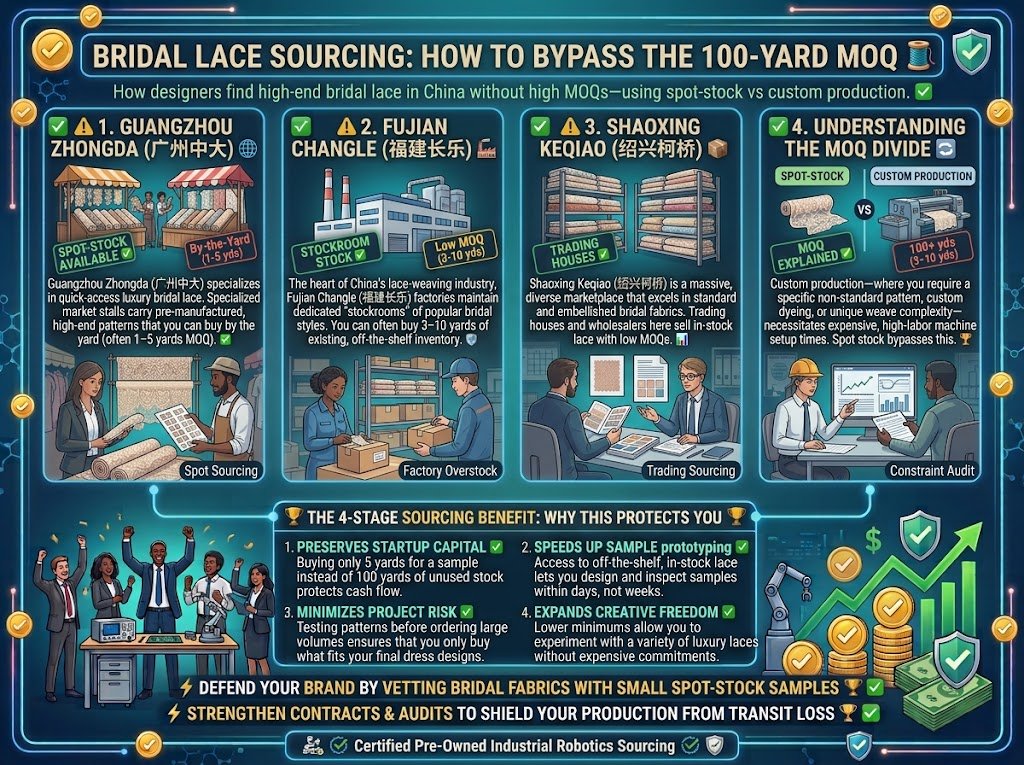
High-end bridal lace with no MOQ in China is available through spot-stock market stalls in Guangzhou, source factories in Fujian Changle, and fabric trading hubs in Shaoxing Keqiao. Stock lace from these markets can often be ordered in as few as 3–5 yards per pattern. Custom production still carries a minimum, typically 30–100 yards depending on weave complexity and dyeing requirements.
I run Bridal Sourcing, a sourcing studio based in Shenzhen and Guangzhou. I spend a significant part of every working week inside the Hongzhou and Zhongda lace markets, or communicating with factory contacts in Fujian and Keqiao on behalf of designers in Europe, South Asia, and the Middle East. This article is what I know from doing it every day — not from a supplier brochure.
Which Lace Market in China Has the Lowest MOQ for Designers?
China has dozens of fabric markets, and most suppliers will tell you they can handle small orders — until you ask for 10 yards of their premium embroidered lace. The real answer depends on which market you are in and what you actually need.
Guangzhou's Zhongda and Hongzhou fabric markets hold the largest spot-stock inventory of bridal lace in China, with MOQs as low as 1–5 yards per pattern for available stock. Fujian Changle is the source for factory-direct lace for lingerie and swimwear. Shaoxing Keqiao is better for sampling designer-weight fabrics and usually has slightly higher starting minimums.
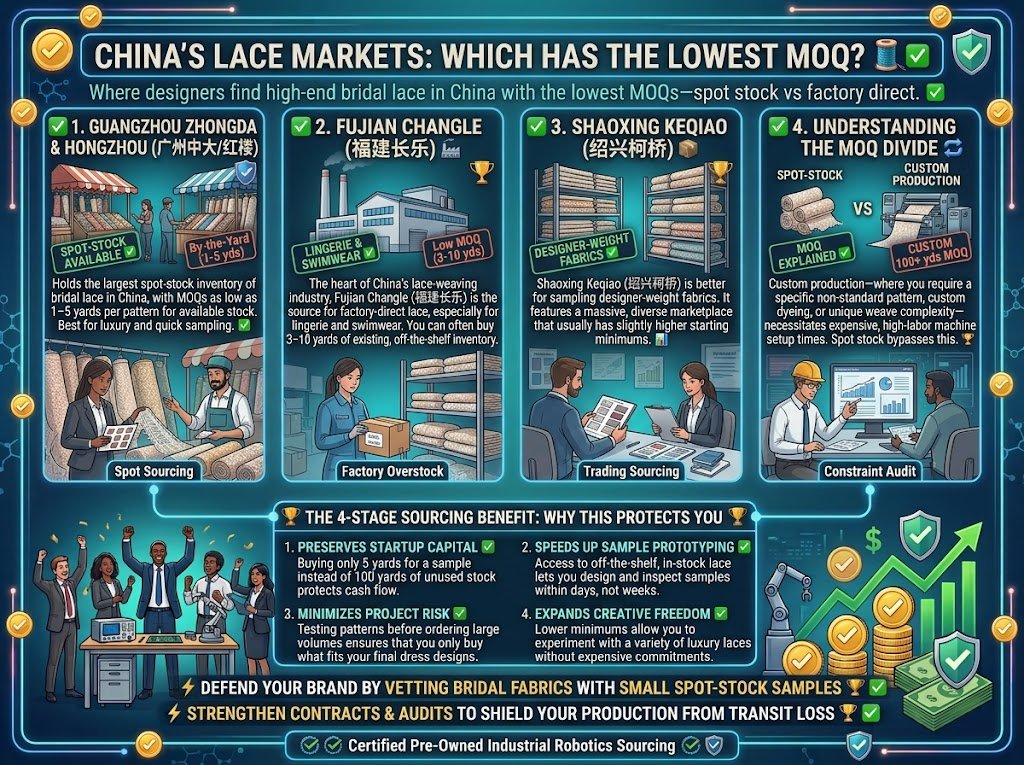
The Four Main Lace Sourcing Channels — Compared
| Market | Location | Best For | Typical Spot MOQ | Notes |
|---|---|---|---|---|
| Zhongda Fabric Market | Guangzhou | Bridal lace, evening wear, embroidered trims | 1–3 yards | Largest variety; good for in-person browsing |
| Hongzhou Fabric Market | Guangzhou | Bridal, cheongsam, designer women's wear | 3–5 yards | Strong for premium lace and tulle combinations |
| Changle Lace Factories | Fujian Province | Lingerie, swimwear, soft stretch lace | 5–30 yards | Factory-direct pricing; lower cost per yard |
| Keqiao Fabric Market | Shaoxing, Zhejiang | Formal wear, chiffon, designer fabrics | 10–50 yards | Better for sampling wovens and structured fabrics |
Which market fits your project:
- 📍 Near Shenzhen and want to handle the fabric yourself → Go to Guangzhou Hongzhou or Zhongda, browse spot stock in person
- 👙 Making lingerie, sleepwear, or swimwear → Ask Fujian Changle factories first
- 👗 Making formal gowns, cheongsam, or designer women's wear → Guangzhou or Keqiao for samples
- 🌍 Based overseas and cannot travel → A China-based sourcing agent with active market relationships can pull swatches and film stock for you
With our established supply chain connections across these markets, we can typically access stock lace from as low as 5 yards per pattern — though minimums vary by lace type. Our fabric and lace sourcing service covers all four sourcing channels on behalf of overseas designers.
Why Does "No MOQ" Lace Still Come With Conditions?
You see "No MOQ" on a supplier page. You feel relieved. Then you message them and discover that the specific pattern you want requires 30 yards minimum. Here is why this happens — and what to ask instead.
"No MOQ" in Chinese bridal fabric sourcing usually means free sampling or spot-stock availability, not that custom production has zero minimums. Dyeing, Jacquard weaving, and embroidery setup all require minimum yardage to be commercially viable. The difference between spot stock and custom production is the most important distinction to clarify before you spend any time on a supplier.
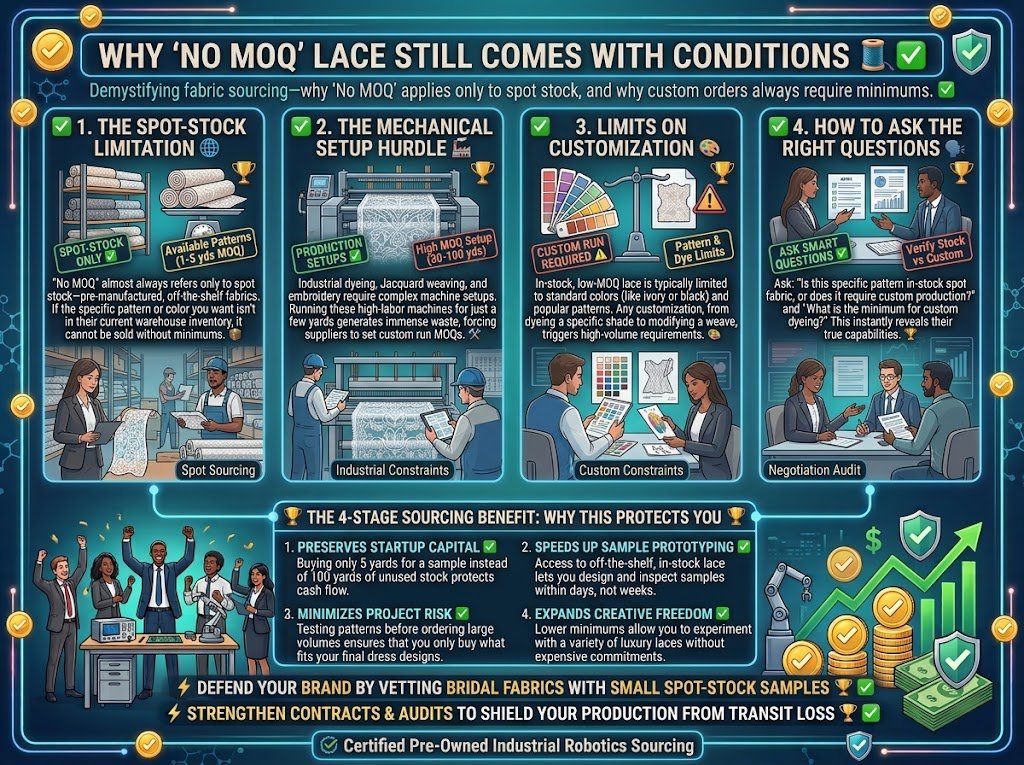
What "No MOQ" Actually Means — and What It Does Not
| Claim | What It Usually Means | What It Does Not Mean |
|---|---|---|
| "No MOQ" | Spot-stock yardage available in small cuts | Custom colour dye runs or new embroidery setups have no minimum |
| "Free samples" | A swatch or cutting is sent at no cost | A production-ready sample gown or meter of fabric is free |
| "Small batch friendly" | 5–30 yards is possible for stock patterns | Any pattern in any quantity is available on demand |
| "Custom available" | The factory can produce this pattern to order | Custom orders have the same low MOQ as stock orders |
The real questions to ask before assuming "no MOQ":
- ✅ Is this pattern currently in stock, or does it require custom production?
- ✅ What is the minimum for spot-stock orders versus made-to-order?
- ✅ Is the sample a free cutting, or is there a swatch fee?
- ✅ If I return for bulk production, will this pattern still be available?
- ✅ What is the lead time for a stock order versus a custom dye run?
Personally, when I source for clients, I always distinguish between "this is sitting on a shelf in Guangzhou right now" and "this can be made if you order enough." The first gets you 5 yards next week. The second gets you a negotiation.
How Do You Source Bridal Lace If You Are Not in China?
You cannot fly to Guangzhou to feel the fabric. You are in Sri Lanka, Ireland, or the UK and you need to make a fabric decision from a screen. Here is how designers do it remotely — and what separates a good result from an expensive mistake.
Remote bridal lace sourcing works best when you combine a downloadable pattern catalog for initial shortlisting, real natural-light video confirmation of drape and texture before ordering, and a local sourcing agent who can physically pull stock and ship swatches. Still photographs lie; video in natural light does not.
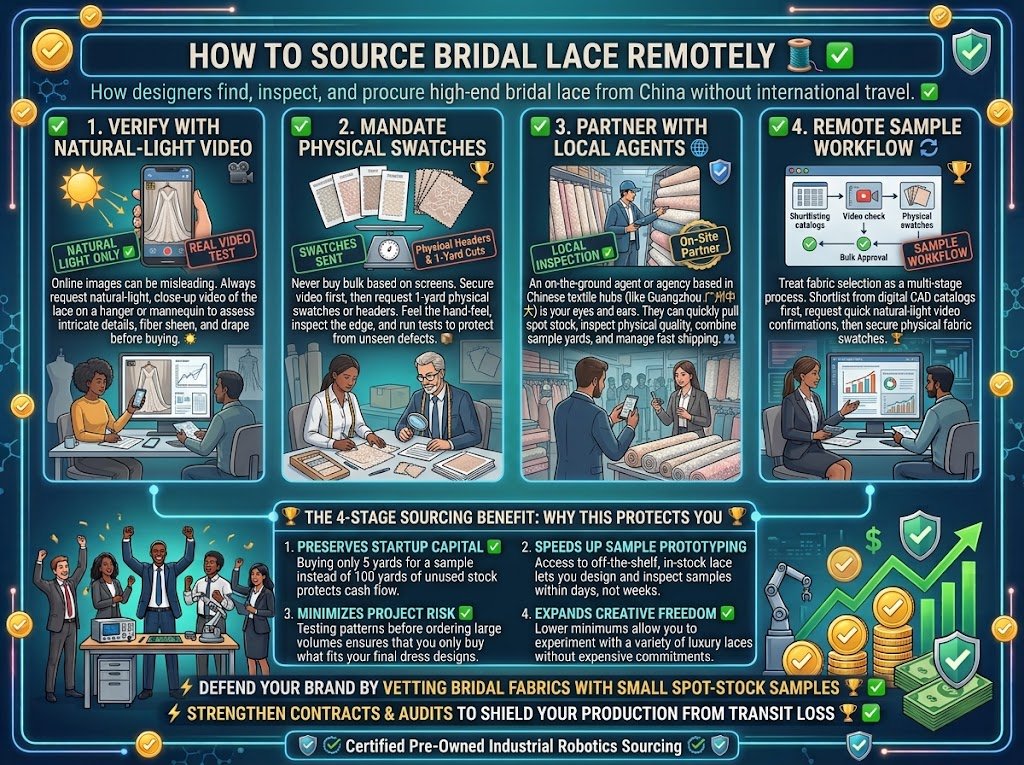
The Remote Sourcing Workflow That Works
I recently worked with a designer based in South Asia who was building her bridal line remotely without ever visiting China. She found our lace catalog online, shortlisted patterns by code, and we confirmed everything by video and swatch before she ordered a single yard. Here is the exact process:
Step 1 — Browse by catalog, not by feel
Use a pattern catalog with full style codes and reference images. Trying to source by browsing generic supplier websites one by one is slow and inaccurate. Our lace catalogs give you:
- Eyelash and border lace patterns — sorted by pattern style with reference codes
- All-over bridal lace — full-width options from 130–150 cm, downloadable catalog with 100+ additional patterns at the bottom of the page
Step 2 — Confirm by natural-light video before ordering
Send the style codes you want to check. We film the actual stock in natural light, showing:
- How the lace drapes when held up and moved
- The actual colour (screen photos always shift warm or cool)
- The scale of the pattern next to a hand for proportion reference
Step 3 — Receive swatches before committing to yardage
For patterns you are serious about, we can arrange fabric cuttings to be shipped to you directly. Physical confirmation before a bulk order is always worth the small swatch cost.
Step 4 — Confirm pricing, MOQ, and lead time per pattern
Because each pattern has different stock levels, the available quantity and price vary. We check live stock and provide exact figures — not estimates — before you commit.
Browse our essential fabrics library and premium lace collection to start shortlisting patterns before reaching out.
What Should You Ask Before Ordering a Lace Sample?
Most sourcing mistakes do not happen in production. They happen in the first conversation, when a designer assumes "in stock" means "available in 5 yards" and the supplier assumes a minimum of 30. Both sides feel misled, and no one is wrong — they just never asked the right question.
Before ordering any lace sample from a Chinese supplier, confirm whether sampling is free or paid, the MOQ for spot stock versus custom production, the effective width of the fabric, the lead time for stock orders versus custom runs, and whether the pattern will still be available when you need bulk production later.
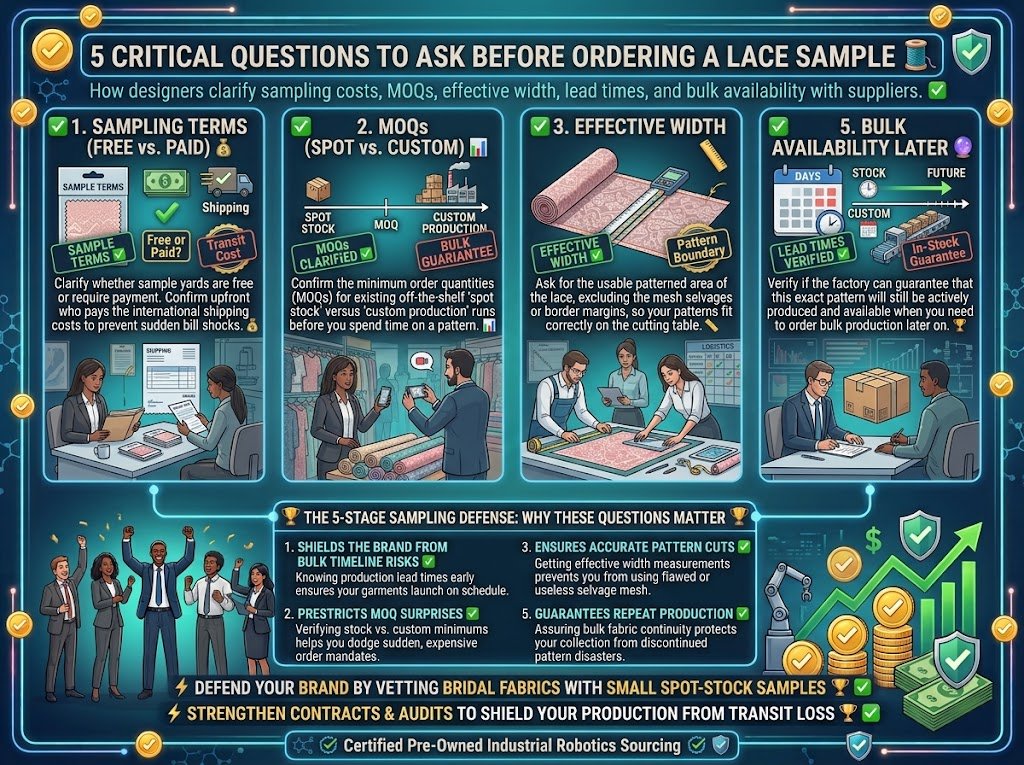
The Five Questions Every Designer Should Ask First
Before any lace order — ask these:
"Is this pattern currently in stock, or is it made to order?"
Stock = fast, low MOQ. Made to order = longer lead time, higher minimum."What is the minimum quantity for spot stock? What is the minimum for bulk production?"
These are two different numbers. Know both before you get excited about a pattern."Is sampling free? Or is there a swatch / cutting fee?"
Most stock suppliers provide free swatches. Custom production sampling may carry a fee. Clarify this upfront."What is the effective width?"
A pattern listed as "150 cm wide" may have an embroidered section of only 34 cm with plain tulle borders. The effective usable width is what matters for cutting."Will this pattern still be available in 2–3 months when I need bulk?"
Stock patterns go out of availability. If you are developing a collection, confirm whether the supplier can hold stock or reorder the same pattern for you.
A bridal fabric swatch book for designers — a physical collection of confirmed-available patterns with codes, widths, and pricing — is the most efficient way to start this conversation. Ask us about our current available swatches at our sourcing service page.
How Do Independent Designers Handle Small Batch Lace Sourcing?
You are not a factory. You do not buy 100 yards in one go. But you still need reliable supply, consistent quality, and a source that will restock the same pattern when your next order arrives six months later. Here is how that actually works for small labels.
Independent designers sourcing bridal lace in small batches benefit most from maintaining relationships with stock-holding suppliers, not custom production factories. Stock suppliers can reorder the same pattern multiple times at the same quality. Custom factories require minimum commitments before the first yard is woven. Matching your sourcing model to your order volume matters more than chasing the lowest unit price.
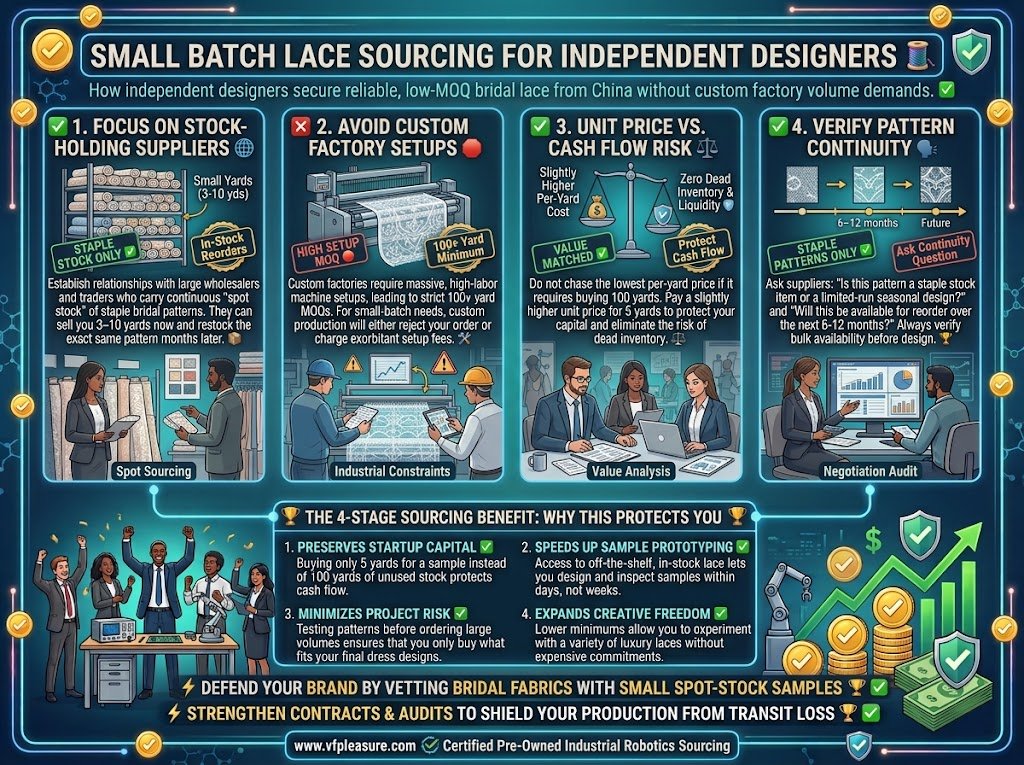
Stock Sourcing vs. Custom Production — How They Compare for Small Labels
| Factor | Spot-Stock Sourcing | Custom Production |
|---|---|---|
| Minimum order | 3–10 yards typical | 30–100+ yards depending on pattern |
| Lead time | Days to 2 weeks | 4–12 weeks |
| Price per yard | Higher (convenience premium) | Lower at volume |
| Pattern reorder | Depends on supplier stock levels | Consistent if factory keeps the setup |
| Best for | Sampling, MTO orders, first collections | Established styles with repeat orders |
| Risk | Pattern may go out of stock | Upfront commitment before quality is proven |
What this means in practice for different designers:
- 🧵 Just starting out → Use spot stock exclusively until you have proven sell-through on at least 2–3 reorders of the same pattern
- 📦 Running a made-to-order boutique → Spot stock with a reliable sourcing agent who tracks your patterns is the most efficient model
- 🏷️ Launching a private label collection → Develop a custom production run only after the sample proves the pattern and the market response confirms the demand
Our small batch production service and pattern and sampling service are both structured around this exact logic. We do not push designers toward custom production minimums before they have a proven sample. Start with stock, prove the pattern, then commit to production when the numbers support it.
You can explore our current bridal accessories wholesale options — including veils, trims, and lace-embellished accessories — at our bridal accessories collection. For full gown development alongside fabric sourcing, see our complete services overview and our full collection page.
Conclusion
The lowest MOQ in China is not a website claim. It is a relationship with a supplier who has the right pattern in stock today. Start with spot stock, confirm by video, and build your collection one proven pattern at a time.
My Role
About Me
Hello, I am Kelly — founder and sourcing partner at Bridal Sourcing. I have spent more than 20 years managing high-end bridal supply chains in China, working across fabric sourcing, pattern development, and full production management for international labels. My studio is based in Shenzhen and Guangzhou — at the center of the global bridal manufacturing supply chain.
I work as a fabric sourcing agent and production partner for independent designers and boutique owners who need real access to the Chinese lace markets — not just a website catalog. I am your eyes and ears on the ground.
- Email: kelly@bridalsourcing.com
- WhatsApp: +86 180 9894 9773
- LinkedIn: linkedin.com/in/bridalsourcing
- Instagram: instagram.com/bridal_sourcing
What I help with:
- Fabric and lace sourcing — high-end tulle, satin, eyelash lace, and all-over bridal lace with low spot-stock MOQ
- Eyelash and border lace catalog — browse current patterns with style codes
- All-over bridal lace — full-width options, downloadable 100+ pattern catalog at the bottom of the page
- Pattern making and sample development — from sketch to prototype using your selected fabric
- Small batch production — 5 to 30 pieces per style for boutique brands and emerging labels
More sourcing guides and real project stories are on our blog.