You have a sketch, a vision, and a boutique full of customers asking for something no one else sells. You contact three factories. All three want a 300-piece minimum order. Your idea dies before it starts.
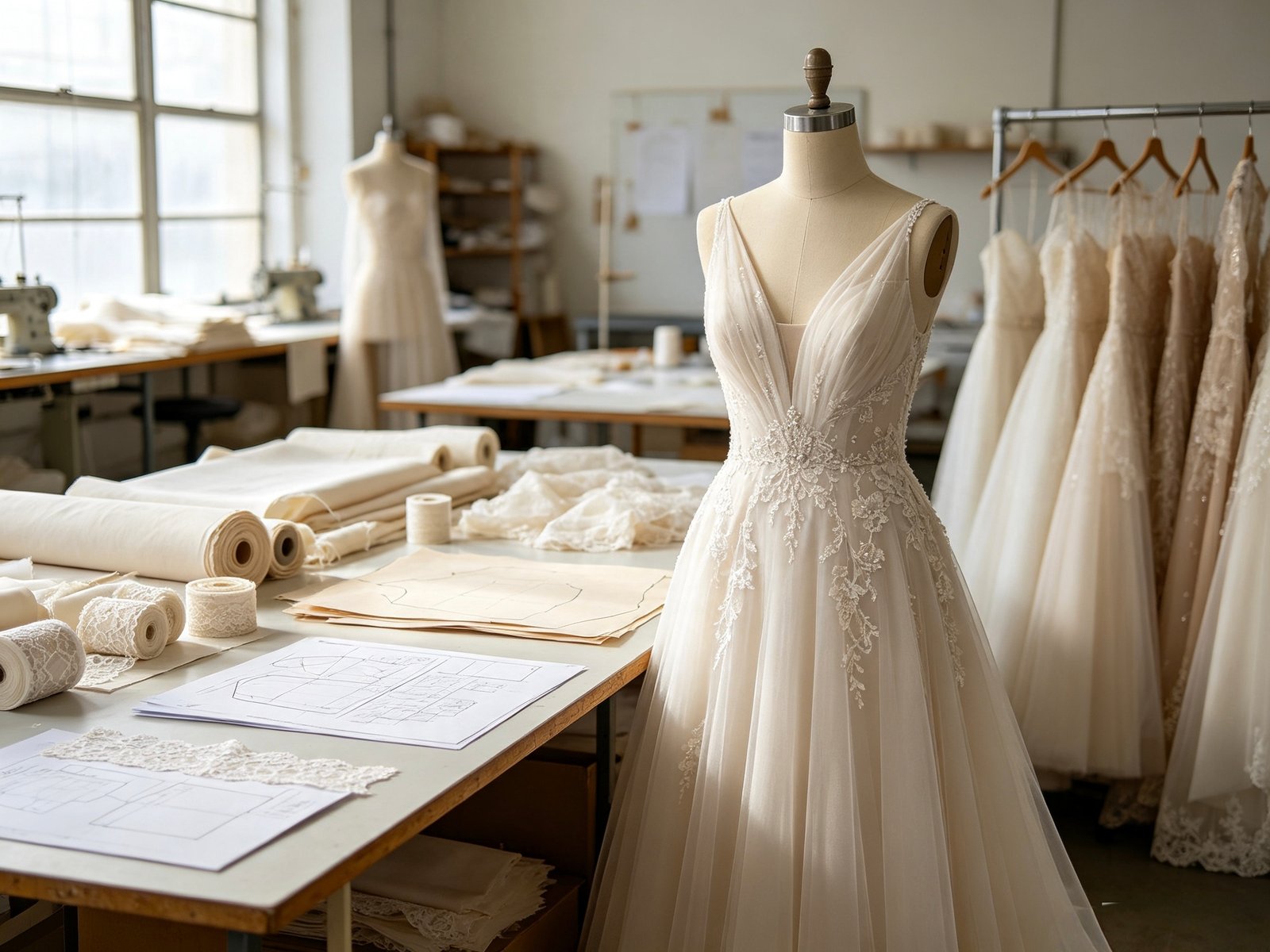
A small batch wedding dress manufacturer develops your original design from scratch, produces a single prototype, and scales to 5–30 pieces per style for wholesale. No bulk contract is required at the start. You approve fabric, pattern, and quality before committing to inventory.
I have spent more than 20 years in the bridal supply chain here in China. I run Bridal Sourcing, a sourcing studio and production partner for independent designers and boutique owners around the world. Two of my recent clients — a boutique owner from Ireland I will call Emma, and an established UK brand founder I will call Claire — both launched their own private label collections starting with a single sample order. Neither had a tech pack. Neither had a factory relationship. Both had a clear vision, a small budget, and a deadline. This article is their story, and a complete guide for anyone standing exactly where they stood.
- Can You Really Start a Bridal Label With Just One Sample?
- How Do You Protect Your Design Before Sharing It?
- What Does a Bespoke Bridal Sample Actually Cost?
- How Do You Control Quality When the Factory Is Thousands of Miles Away?
- When Is It Time to Move From One Sample to a Full Collection?
- Conclusion
- My Role
Can You Really Start a Bridal Label With Just One Sample?
Most boutique owners believe they need to fill a warehouse before they can have their own brand. That fear keeps most of them selling other people's labels forever. It does not have to work that way.
Yes, you can launch a private label bridal line with a single sample. A legitimate small batch wedding dress manufacturer builds your pattern from scratch, sources and approves fabric, and produces one prototype. No bulk commitment is required. This sample proves fit, quality, and production cost before you invest in inventory.
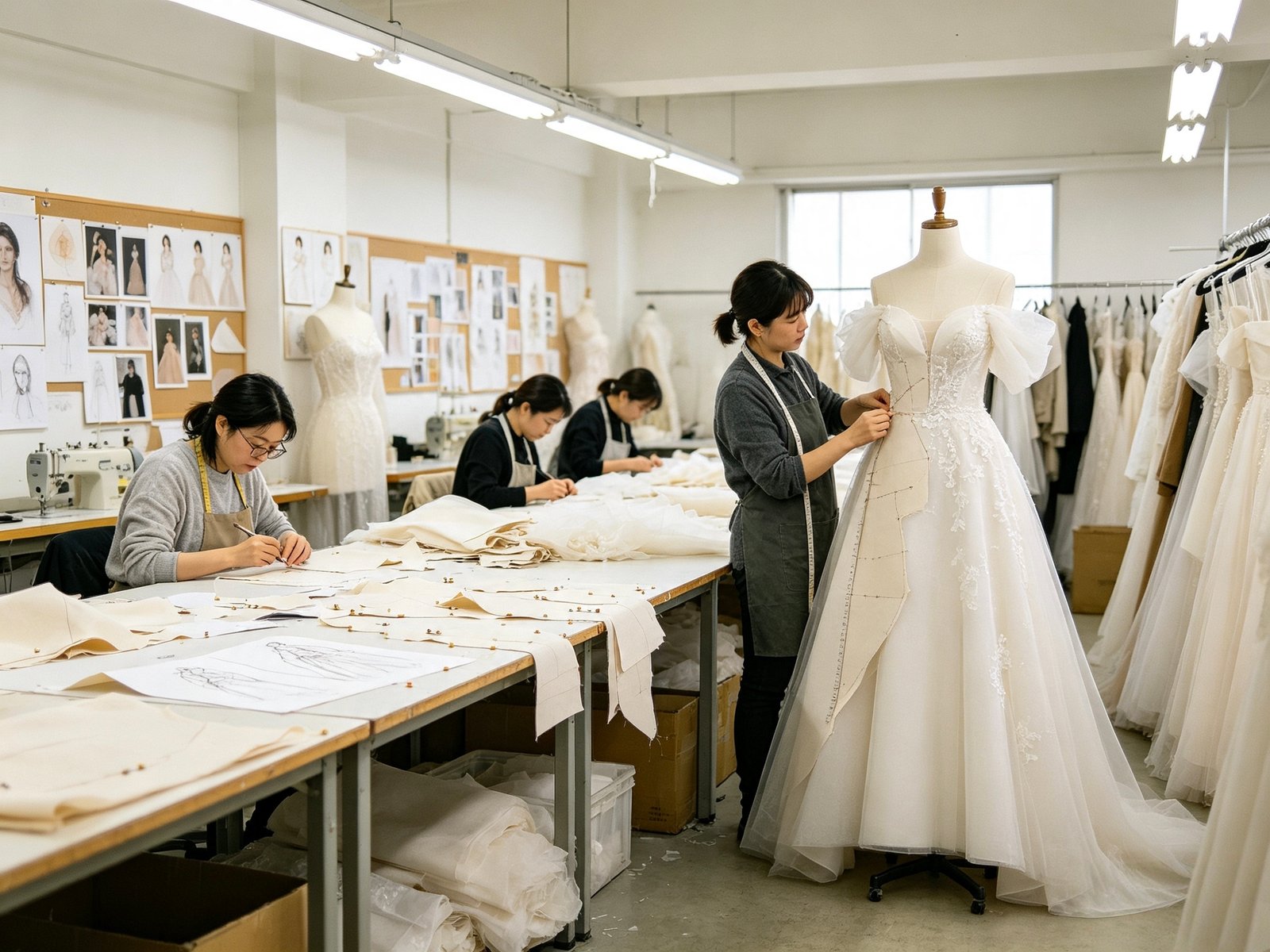
How Emma Started With One Corset Dress and a Gap in Her Market
Emma owned a boutique in Ireland and had sold other brands for years. She wanted her own label. Her plus-size brides kept requesting a structured Mikado corset dress that no supplier stocked — so she sketched one and sent it to me.
We built it as a true OEM bridal wedding dress development: original pattern, her design, her brand. Here is what that one sample required:
| What We Built | Why It Mattered |
|---|---|
| Custom pattern from scratch (no factory base block) | Her design, not a factory template with her label |
| Reinforced internal bust cups | Plus-size support without needing a separate bra |
| Internal boning structure | Holds shape for a full wedding day, not just photos |
| Clean Mikado finish | Zero-forgiveness fabric — every error shows |
What happened after the sample arrived:
- Brides in her boutique placed orders immediately
- She added a detachable overskirt option a few months later
- Her customers stopped comparing her to other stores — because no other store had her dress
That is the entire model. One sample proves the concept. Real orders tell you whether to scale. You can see how we structure each stage at our process page.
How Do You Protect Your Design Before Sharing It?
You have something original. You need to send it to a factory on the other side of the world to make it real. Nothing stops that factory from producing your design for someone else next season — unless you make it legally impossible.
An NDA (Non-Disclosure Agreement) signed before any sketch is shared gives you full IP ownership of all patterns and prototypes developed for your brand. The factory cannot reproduce, adapt, or sell your design to any other client. This agreement is the standard starting point for ethical wedding dress production in China with any professional manufacturing partner.
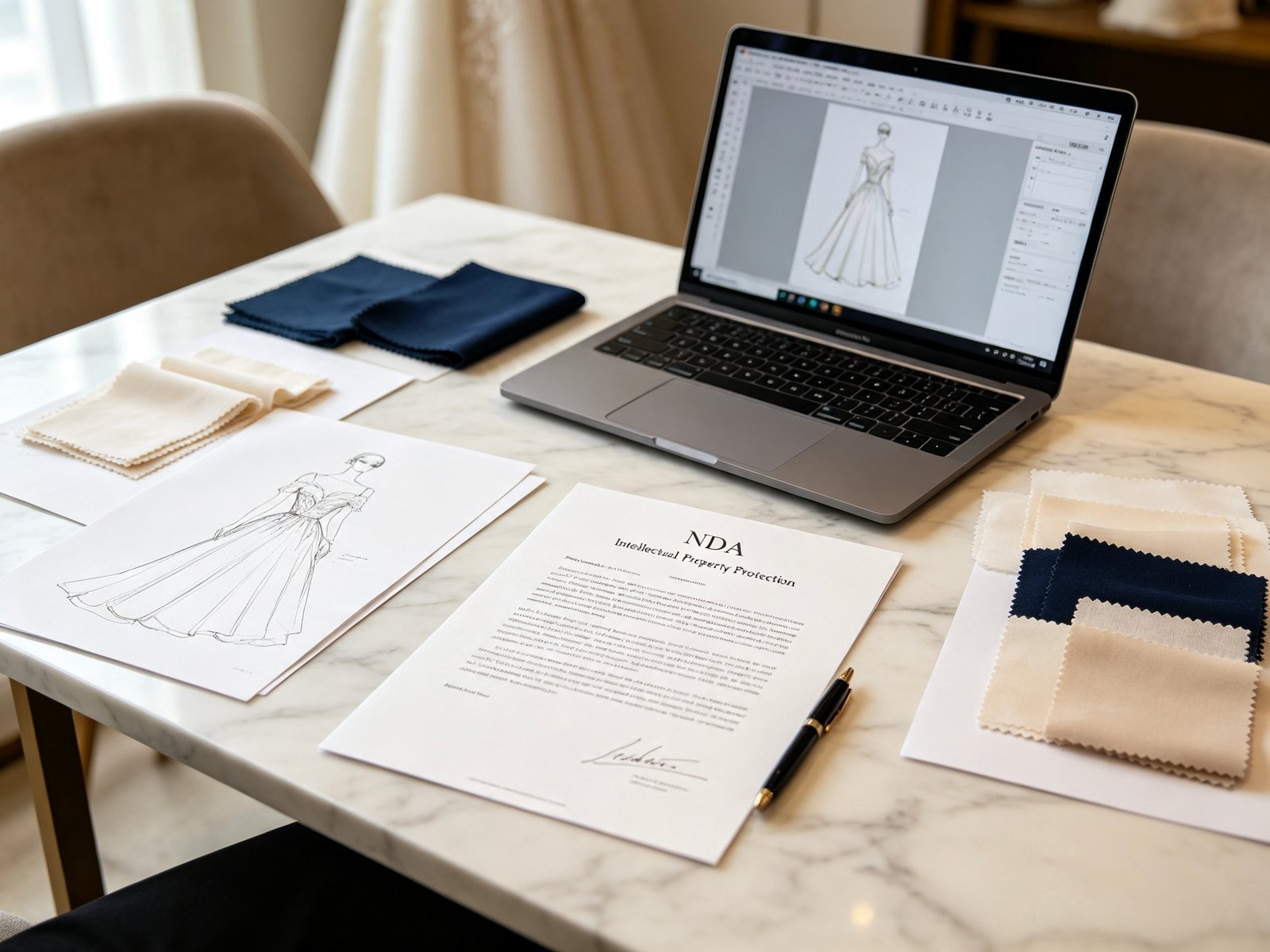
What Claire's NDA Negotiation Revealed About the Right Factory
Claire ran an established bridal brand in the UK with ten styles ready to develop. Her first question was not about price. It was about IP protection. She sent her own NDA draft before sharing a single image.
What a well-structured NDA should cover:
- ✅ All designs, patterns, and prototypes developed belong exclusively to you
- ✅ The factory cannot reproduce or sell your designs to any other client
- ✅ IP transfers to you upon full payment of the sample invoice
- ✅ The factory's pre-existing production knowledge (their own base blocks and techniques) stays theirs — keeps the agreement fair and workable
One clause we negotiated — and why it matters:
Claire's original draft held us liable for any leak, including leaks from her side of the chain. We revised it: we take full liability for breaches within our direct control. We do not accept liability for disclosures we cannot control. She agreed. Both parties signed the same day.
The test is simple: A factory that refuses to sign an NDA, delays without reason, or proposes language assigning your designs to them is disqualifying itself. Walk away.
Learn more about how we work at our about page.
What Does a Bespoke Bridal Sample Actually Cost?
You search for sample prices and find quotes ranging from $80 to $3,000. That range is too wide to be useful. Here is what the number actually reflects when you are doing genuine custom development.
A bespoke bridal sample with original pattern making, custom fabric sourcing, internal corsetry, and hand-finishing costs between $450 and $900 per piece depending on complexity. This fee covers R&D — pattern drafting, fabric testing, structure engineering. Simpler styles without beading or boning cost less. The sample price is always higher per unit than bulk because you are paying for development, not production volume.
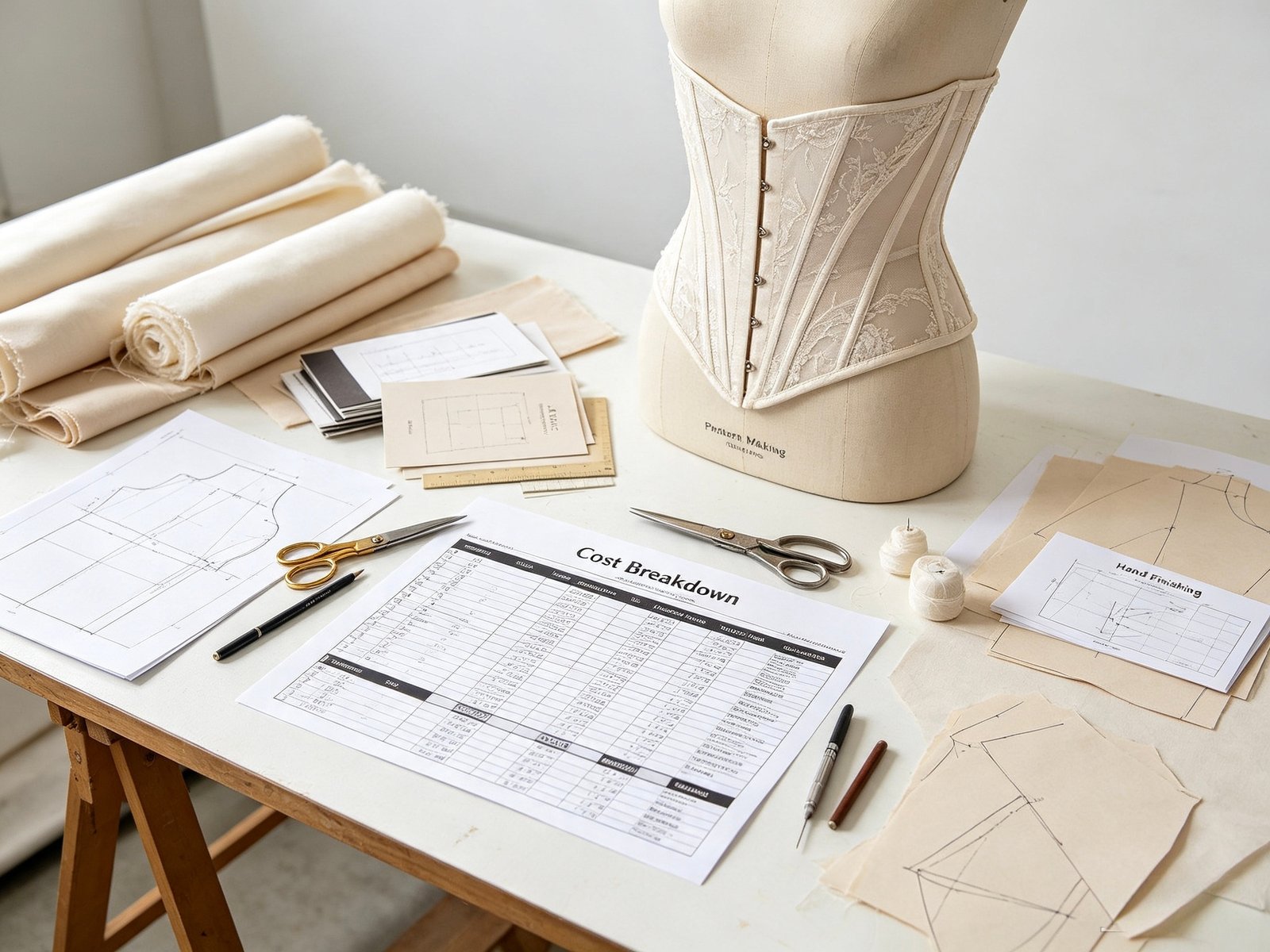
The Real Breakdown Behind Emma's $540 Sample Price
Emma's corset Mikado dress came in at $540. Her first reaction was that it sounded like a lot. Here is what it actually included:
| Line Item | What It Covers |
|---|---|
| Pattern development | Custom drafting from scratch, plus-size adjustments — no factory shortcut |
| Fabric sourcing & testing | 3 Mikado options filmed in natural light, ordered only after her approval |
| Internal corset construction | Boning, bust cups, waist channel, clean inner lining |
| Hand-finishing | Pressed seams, covered buttons, edge details that define luxury quality |
Key pricing logic to understand:
- The $540 covers development — building the pattern and proving the construction
- Once the pattern exists, bulk production of 10+ pieces costs significantly less per unit
- You pay for R&D once, not every time you reorder
For accessories, the same applies. Claire's cathedral veil with machine-secured pearl edging and custom lace was priced to cover lace sourcing through our fabric and lace sourcing service, the soft illusion tulle from our essential fabrics library, and specialized finishing. We recommended machine-secured beading specifically — hand-stitching on fine tulle can pull the fabric and allow pearls to detach. Browse our premium lace collection — no MOQ for sampling.
How Do You Control Quality When the Factory Is Thousands of Miles Away?
You wire the money. Weeks pass. You have no idea if anything looks like your sketch. That is not an irrational fear. It is exactly what happens when there is no structured approval process.
Remote bridal quality control requires a confirmed written approval at every production stage before moving forward. Fabric is approved by video before ordering. Lace placement is photographed before sewing. The finished sample is filmed before shipping. Nothing advances without your explicit confirmation. This multi-stage gate system prevents expensive surprises and gives you full creative control regardless of distance.
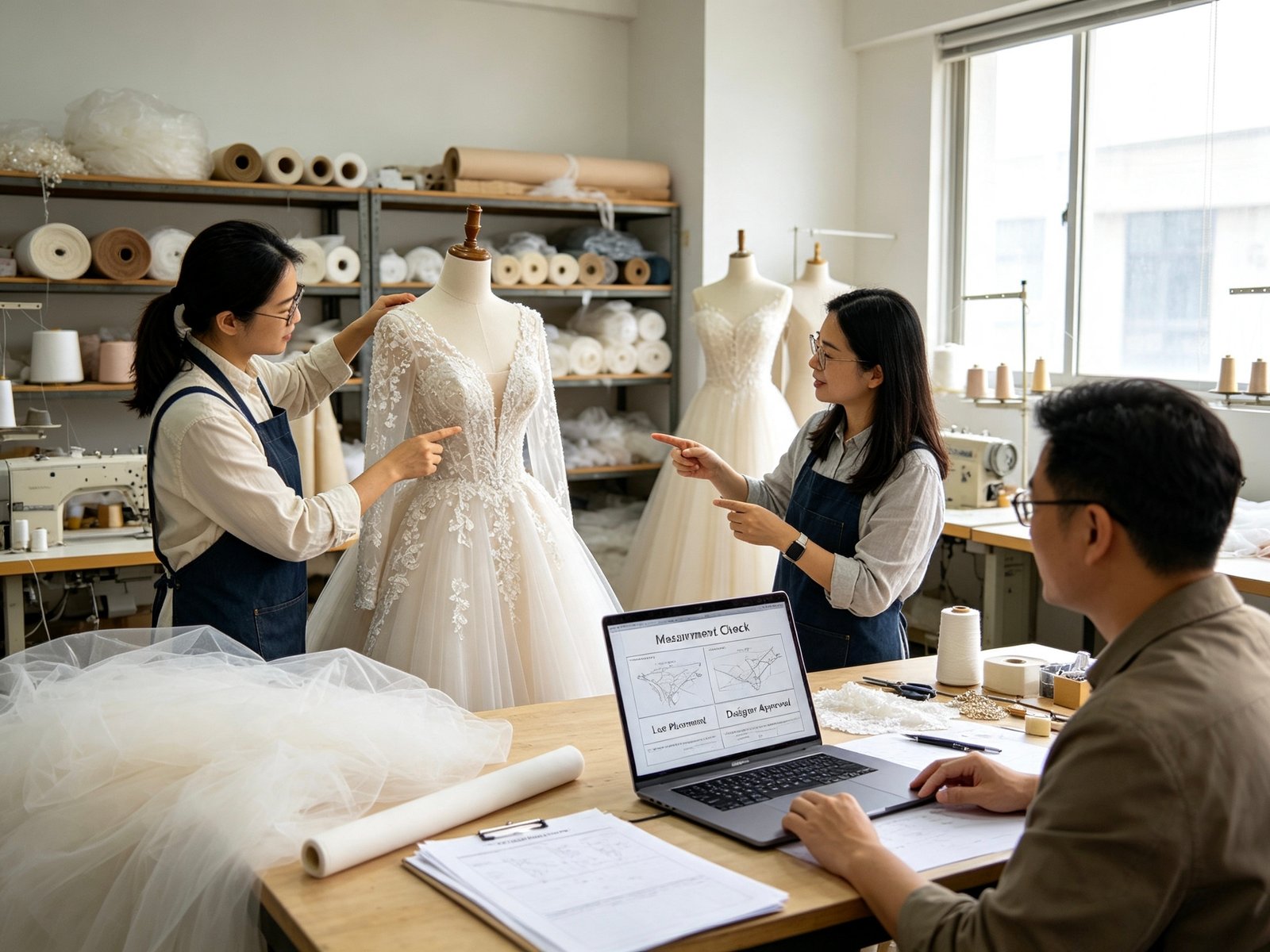
The Two Technical Problems We Caught Before They Became Disasters
Emma's project surfaced two issues during the pattern phase — both caught before cutting, both avoided at zero extra cost.
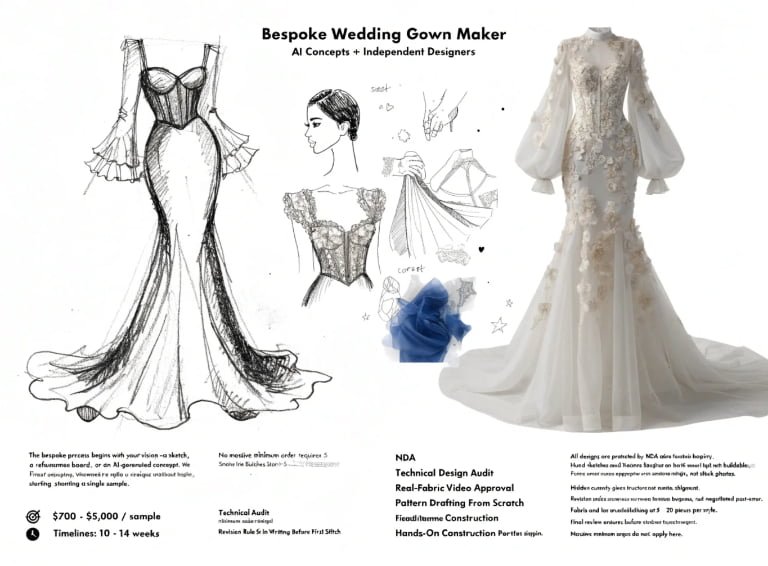
Problem 1: Structural impossibility in the AI sketch
| What the image showed | What was actually impossible |
|---|---|
| Asymmetric shoulder strap design | Front and back strap widths didn't match — they cannot physically connect over the shoulder |
What we did: Sent two diagrams with options. Emma chose one by return message. Problem solved before any fabric was touched.
Problem 2: Slit height proportion error
| Her specification | The real-life result |
|---|---|
| Slit starting 15 inches from the hem | On a 41-inch midi dress, only 9 inches of fabric above the natural waist — dangerously exposing |
What we did: Asked for her total body height and heel height. Recalculated the correct proportion. Updated the pattern before cutting.
The approval system that prevents surprises:
- 📋 Fabric confirmed by natural-light video before ordering
- 📋 Lace placement photographed before sewing
- 📋 Trim and hardware samples approved before production starts
- 📋 Finished sample filmed before shipping
- 📋 Nothing advances without a written yes
For Claire's project, we created a 14-page fabric and lace PDF with clickable video links and a Development Tracker spreadsheet. When her sample arrived, nothing was a surprise — every detail matched exactly what she had confirmed on screen. See how this fits into our full workflow at our pattern and sampling service and small batch production page.
When Is It Time to Move From One Sample to a Full Collection?
You approved the sample. It is exactly right. Your first customers love it. Now what? Do you order 50 pieces? Do you develop three more styles? Most independent designers freeze here because no one tells them what the next step actually looks like.
Move from sample to small batch production when the prototype confirms fit, quality, and market interest. Start with 5–10 pieces per style to test sell-through before committing to larger minimums. Grow the collection one or two styles at a time. Your sample is a proof of concept and a selling tool — not your launch inventory.
Two Completely Different Growth Paths, Both Working
Emma and Claire took completely different routes after their first approved samples. Both were correct for their situation.
| Emma (Ireland Boutique) | Claire (UK Established Brand) | |
|---|---|---|
| Starting point | 1 sample dress | 2 dresses + 2 veils |
| Business model | Made-to-order from live boutique display | Wholesale accounts + retail launch |
| First production run | 5–10 pieces reordered as sold | 10+ pieces per style for wholesale |
| Inventory risk | Near zero — only ordered what was already sold | Managed — launched when accounts were ready |
| Key result | Brides stopped price-comparing her to other stores | Collection launched directly into existing distribution |
The principle behind both paths:
- ✅ Neither committed to bulk before the sample proved quality
- ✅ Neither built inventory without proof of customer demand
- ✅ Both scaled based on real market data, not factory pressure
A $600 sample that prevents a $6,000 production mistake pays for itself twenty times over. A sample that converts brides while your competitors sell the same catalog styles pays for itself in a completely different way.
Browse our services overview to see how fabric sourcing, pattern development, and small batch production connect into one workflow. Explore our full collection page and bridal accessories wholesale options — including veils, detachable sleeves, and custom bridal veil private label pieces — developed alongside custom gowns.
Conclusion
One sample. Approved fabric. Confirmed quality. Small first run. That is the entire sequence. You do not need a massive MOQ to start a bridal label — you need the right partner.
My Role
About Me
Hello, I am Kelly — founder and sourcing partner at Bridal Sourcing. I have spent more than 20 years managing high-end bridal supply chains in China, working across fabric sourcing, pattern development, and full production management for international labels. My studio is based in Shenzhen and Guangzhou — at the center of the global bridal manufacturing supply chain.
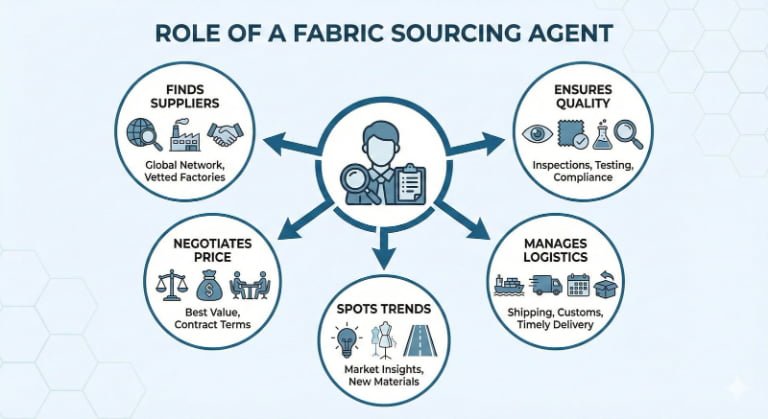
I work as a sourcing agent for independent designers and boutique owners who want real quality, transparent pricing, and a production partner who actually answers their messages. I am your eyes and ears on the ground in China.
- Email: kelly@bridalsourcing.com
- WhatsApp: +86 180 9894 9773
- LinkedIn: linkedin.com/in/bridalsourcing
- Instagram: instagram.com/bridal_sourcing
What I help with:
- Fabric and lace sourcing — high-end tulle, satin, lace, and trims with no massive MOQ for sampling
- Pattern making and sample development — from sketch to prototype, fully original designs
- Small batch production — 5 to 30 pieces per style for boutique brands and emerging labels
- Private label accessories — veils, toppers, detachable sleeves, and cathedral trains
If you have a sketch and a vision, I want to hear about it. Send me a message — I sign the NDA first. More real project stories are on our blog.