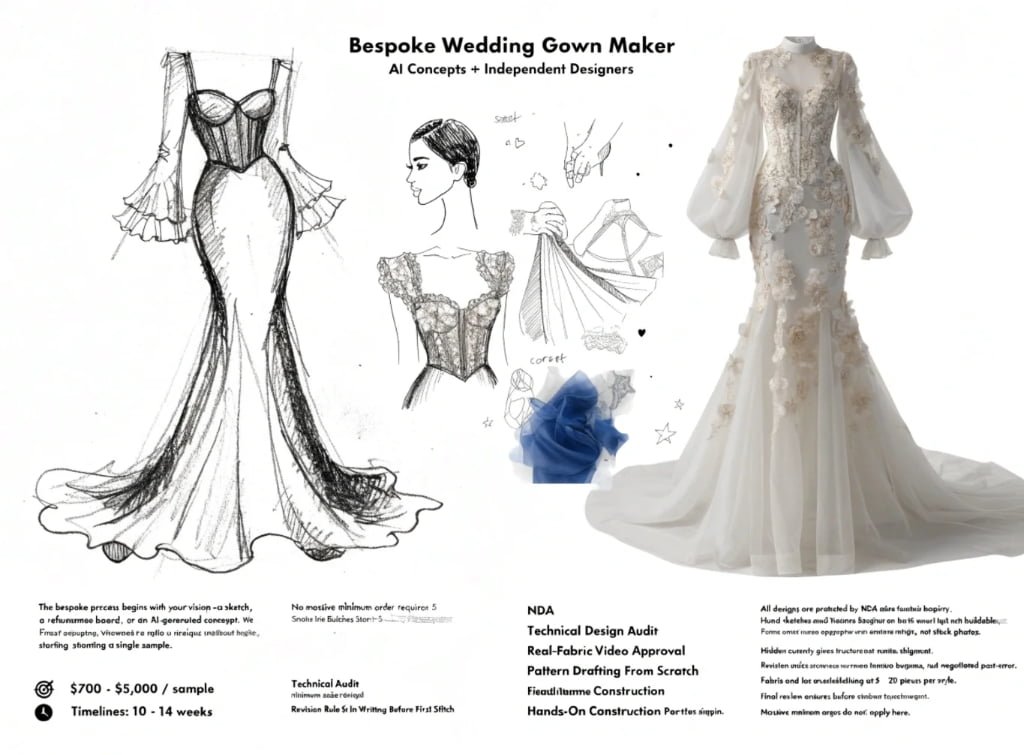
Maybe it's a hand-drawn sketch. Maybe it's two AI-generated concept images and nothing else. Either way, every factory you've contacted wants a 500-piece order, and you only need one sample. That gap kills good ideas before they even start.
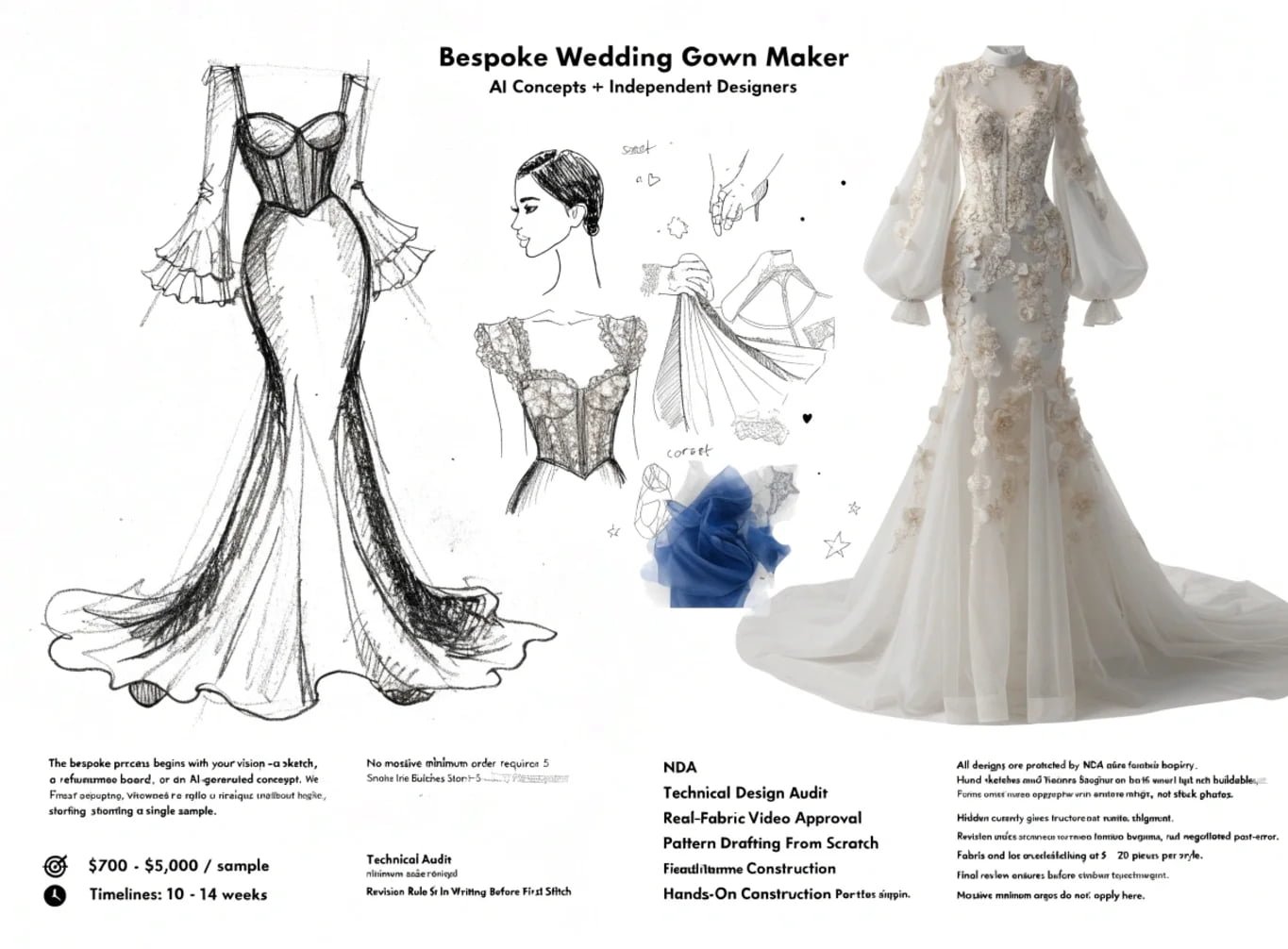
A bespoke wedding dress manufacturer works with independent designers on a single sample, built from a sketch, a reference board, or an AI-generated concept — not from bulk orders or existing factory styles. The process runs through an NDA, a technical design audit, real-fabric video approval, pattern drafting from scratch, hands-on construction, and a final review before shipping. No massive minimum order required.
Quick answers, if you're short on time:
- NDA signed before you share a single sketch or AI concept — the design stays yours.
- Hand sketches and AI-generated concepts are both buildable, after a technical audit catches structural issues AI can't see.
- Fabric and lace approved on real video, in natural light — never a stock photo.
- Hidden corsetry keeps the shape without ever showing structure from the outside.
- No bulk MOQ — samples and small batches start at 5–20 pieces per style.
- A bespoke sample typically runs $700–$2,000 per piece, with a realistic 10–14 week timeline.
- Revision rules are set in writing before the first stitch, not negotiated after a mistake.
I'm Kelly, and I run Bridal Sourcing, a bridal sourcing studio based in Shenzhen and Guangzhou — right in the center of global wedding dress manufacturing in China. Twenty years back, I was sourcing lace to a standard built for large international bridal labels. Today I use that same standard as a sourcing agent and fabric sourcing agent for small, independent labels.
The case running through this guide is real: a designer building her own luxury bridal line in the UAE arrived with two AI-generated concept images, no patterns, and a very specific vision. Ten weeks later, two finished, hand-embellished gowns were on their way to Abu Dhabi. Every step below — the NDA, the fabric video, the corsetry, the approval chain, the timeline — is exactly how that project ran, and exactly what your own project would go through too.
- Will a Bridal Manufacturer Sign an NDA Before I Share My Designs?
- Can a Manufacturer Build a Pattern From a Hand-Drawn Sketch or an AI-Generated Concept?
- How Do You Choose the Right Fabric and Lace From Thousands of Miles Away?
- What Is Hidden Corsetry, and Why Does Your Luxury Gown Need It?
- What Does the Development Process Look Like, Step by Step?
- How Much Does It Cost to Develop a Custom Bridal Sample in China?
- Do I Need a Huge MOQ to Work With a Bridal Manufacturer?
- How Long Does a Custom Bridal Sample Take in China?
- What Happens If the Sample Needs Changes After It's Made?
- Conclusion
- Ready to Start? Here's How
You worked for months on a sketch. The last thing you want is a factory copying it for another client next month. That fear keeps a lot of designers quiet, and stuck.
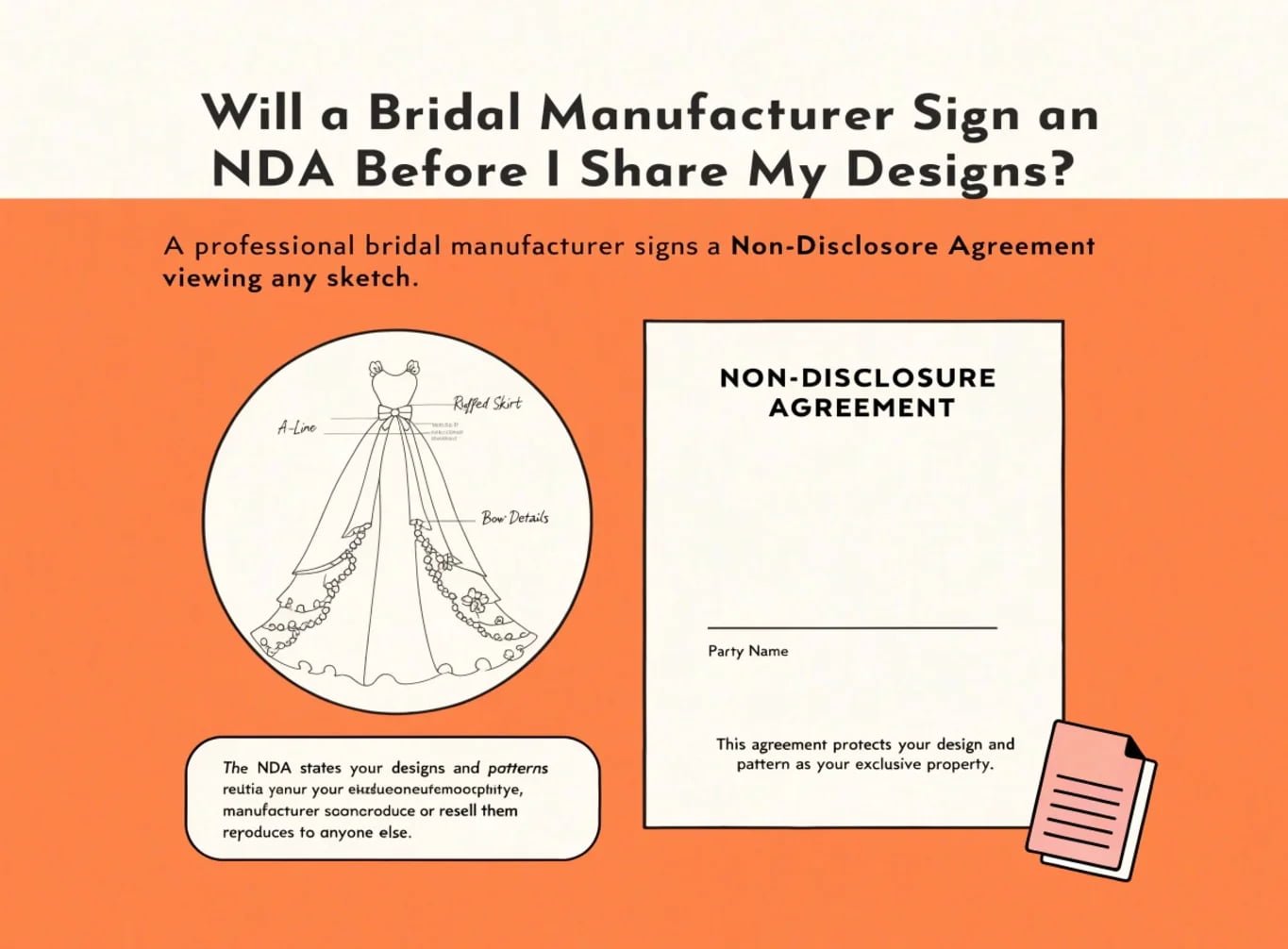
Yes. A professional bridal manufacturer signs a Non-Disclosure Agreement before viewing any sketch. The NDA states your designs and patterns stay your exclusive property, and the factory cannot reproduce or resell them to anyone else.
What a Fair NDA Actually Covers
A good NDA does three jobs. First, it locks the IP to you. Every pattern, sketch, and sample we build stays 100% your property. Second, it sets a time limit, usually five years, on how long we must keep your designs private. Third, it covers what happens if something leaks.
That third part matters more than people think. One client sent over her own NDA draft, and the liability clause held us responsible for any leak, even one caused by people outside our control. I asked for a fair change: we only answer for leaks that come from our own team, not from her side of the world.
She agreed right away. That is what a fair NDA looks like:
It protects your design, and it protects us from blame for something we never touched.
If a manufacturer refuses to even discuss an NDA, that tells you something. Walk away.
Ready to protect a design before anyone else sees it?
That's the first thing we do here, not the last. Start with an NDA → or message me directly on WhatsApp at +8618098949773.
Can a Manufacturer Build a Pattern From a Hand-Drawn Sketch or an AI-Generated Concept?
You have an image. It looks exactly right. But a beautiful image and a buildable pattern are two very different things, and most factories will not tell you that until after you pay.
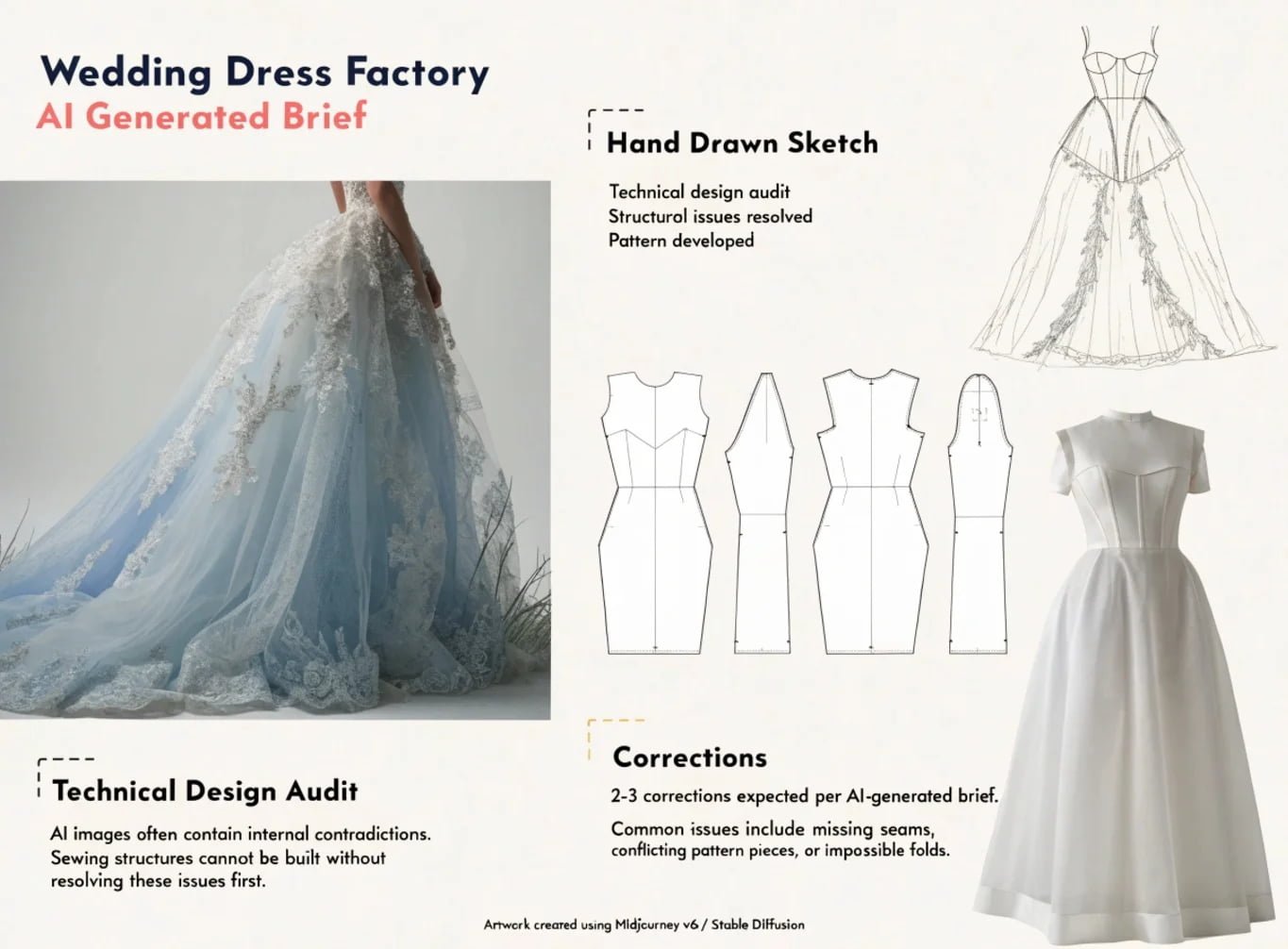
Yes. A wedding dress factory can develop a full pattern from a hand-drawn sketch or an AI-generated concept — but the factory must run a technical design audit first. AI images in particular routinely contain structural impossibilities that a pattern maker must identify and resolve before a single pin is placed. Expect two or three corrections on most AI-generated briefs before the pattern is clean.
The Two Things AI Gets Wrong Every Time
AI tools create concepts. They do not create construction documents. Two issues appear on nearly every AI-generated brief I have reviewed for clients through my pattern and sampling service:
Structural mismatches
On the UAE project, the front shoulder strap of one gown was significantly narrower than the back strap. In the AI image, this looked like an intentional asymmetric design. On a real body, those two straps simply cannot connect over the shoulder. Our pattern maker caught it before a single measurement was transferred to paper.
The client had not noticed. She had been looking at the image for weeks. The fix took one diagram, two options drawn clearly side by side, and one quick decision from her. Done in 24 hours. But it could only happen because a human eye reviewed the sketch before production started.
Proportion errors
AI does not know the wearer's height. The same client specified her thigh slit starting 15 inches up from the hem. That sounds workable on paper. On her actual 41-inch midi dress, 15 inches up from the bottom left only about 9 inches of fabric from her natural waist — the slit would have opened to hip level. Our pattern maker caught it on the paper mold before any fabric was cut.
Instead of asking her to re-measure, we asked two simple questions: her total height and the heel height she planned to wear. Our pattern maker used both to calculate the correct proportion. One follow-up question prevented an expensive and irreversible mistake.
This is what separates true ODM bridal wedding dress and OEM bridal wedding dress development from a factory that simply accepts your files and hopes for the best. You bring the vision. We bring the technical knowledge to make it real and wearable.
How Do You Choose the Right Fabric and Lace From Thousands of Miles Away?
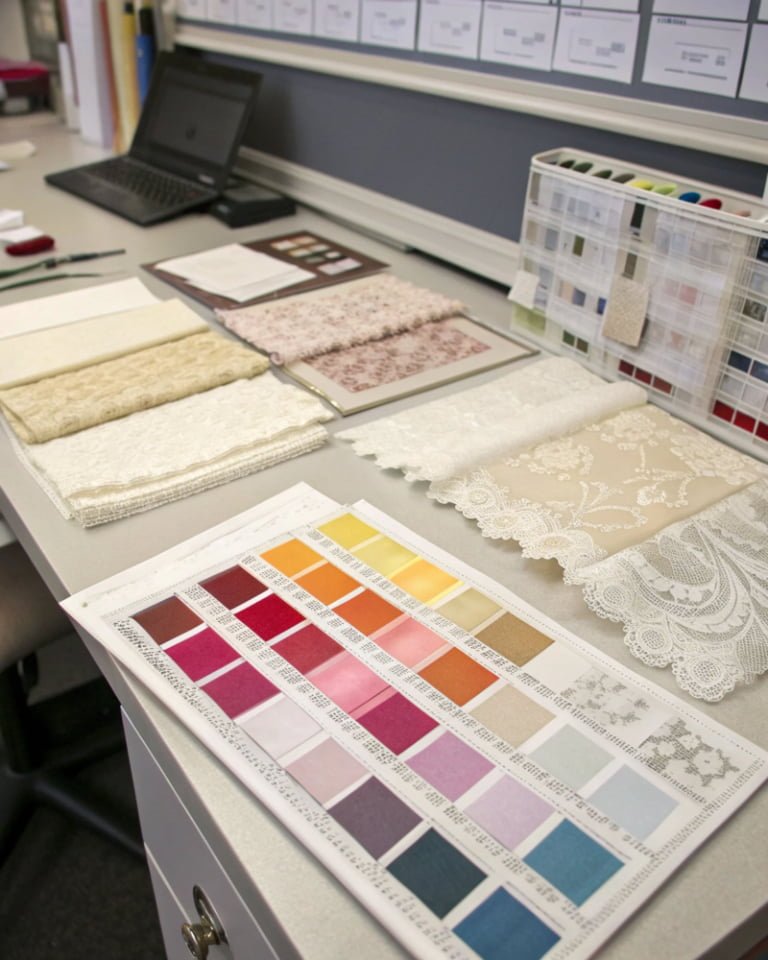
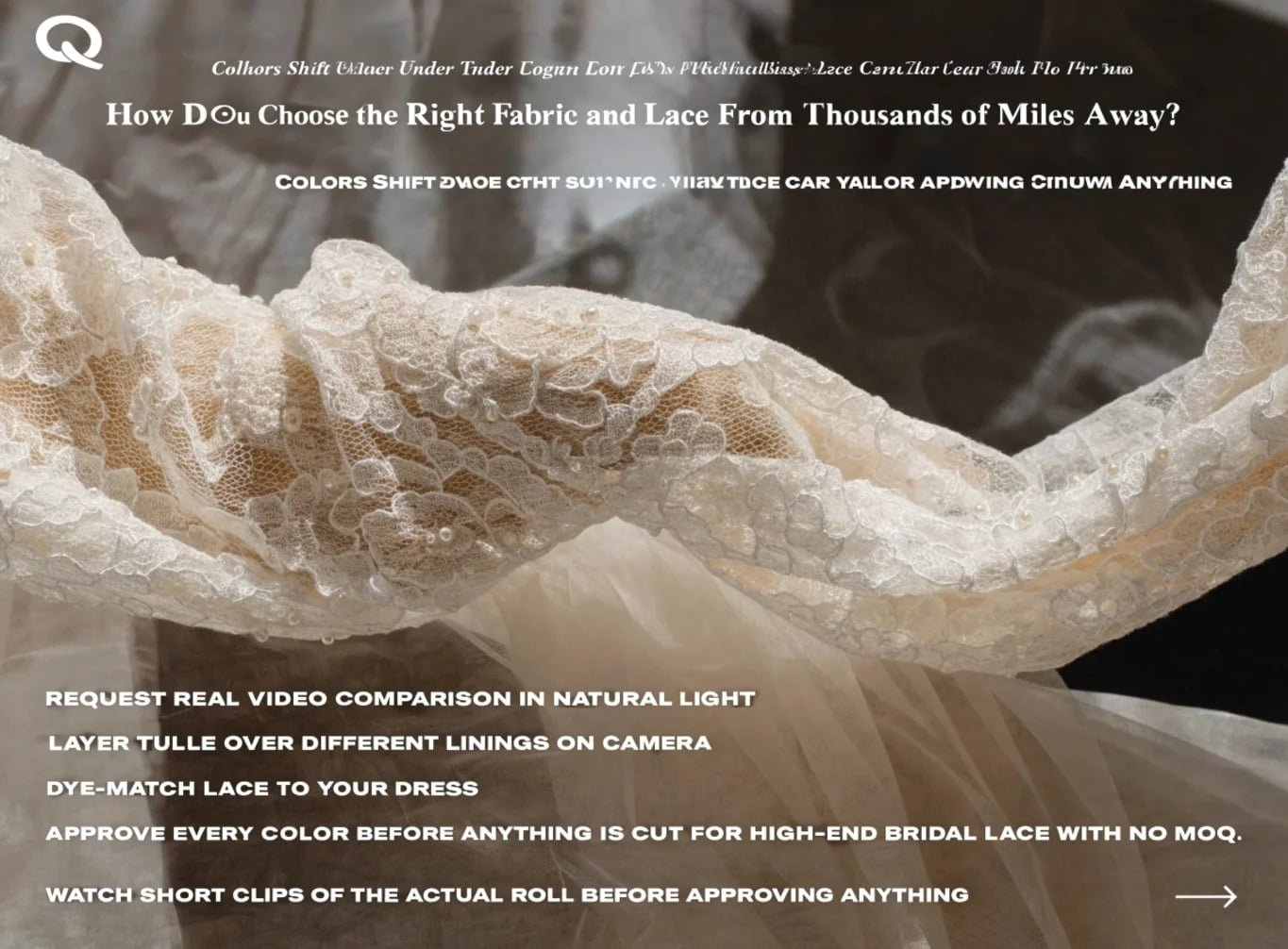
A photo on a screen never shows you how fabric actually moves, or whether that "nude" lace secretly leans yellow. Colors shift under studio lighting. Texture flattens on a phone screen. Without real video, choosing fabric remotely is guesswork.
You choose fabric by requesting real video comparison in natural light, not photos. A good manufacturer layers tulle over different linings on camera, dye-matches lace to your dress, and lets you approve every color before anything gets cut. For high-end bridal lace with no MOQ, ask for short clips of the actual roll before approving anything.
Three Fabric Moments That Decided Two Gowns
Here is how our fabric and lace sourcing service played out across the UAE project, start to finish:
The tulle question
The client saw a single layer of soft tulle filmed close-up on a phone. The camera auto-sharpened the micro-threads and the fabric looked almost like netting. She was right to question it.
I explained what was happening: one layer of fine tulle filmed at close range will always read stiffer than it is in real life. Stack three layers and gather them the way a full skirt sits on a body, and the same fabric transforms into the fluid, veil-like drape she wanted. She trusted the recommendation. We locked the fabric in without needing to source a replacement.
The nude tone
She wanted a cool-toned pale nude — absolutely no yellow undertone. This matters more than most people expect. A warm or yellow-leaning nude reads as dirty and cheap against most skin tones in photographs and in natural light. I confirmed that our light nude matched her reference images exactly, and I committed to sending production photos the moment we started layering.
The lace hunt
She had three favourite options from our premium lace collection. After I explained the cost impact of mixing three different laces in bulk production, she chose one. Then she found a new floral appliqué style in an online image and asked if we could source it. We found it within 48 hours. It became the focal detail of her entire dress.
Our essential fabrics library is browsable at essential fabrics, and if you want to start even smaller, ask for a bridal fabric swatch book for designers before committing to a full sample. You are never picking blind, and never trusting a stock photo from a supplier you have never met.
She wanted her gown to look soft and romantic on the outside. She also needed it to hold its shape through six hours of a wedding reception. Those two goals sound like opposites. They are not — if you understand how hidden corsetry works.
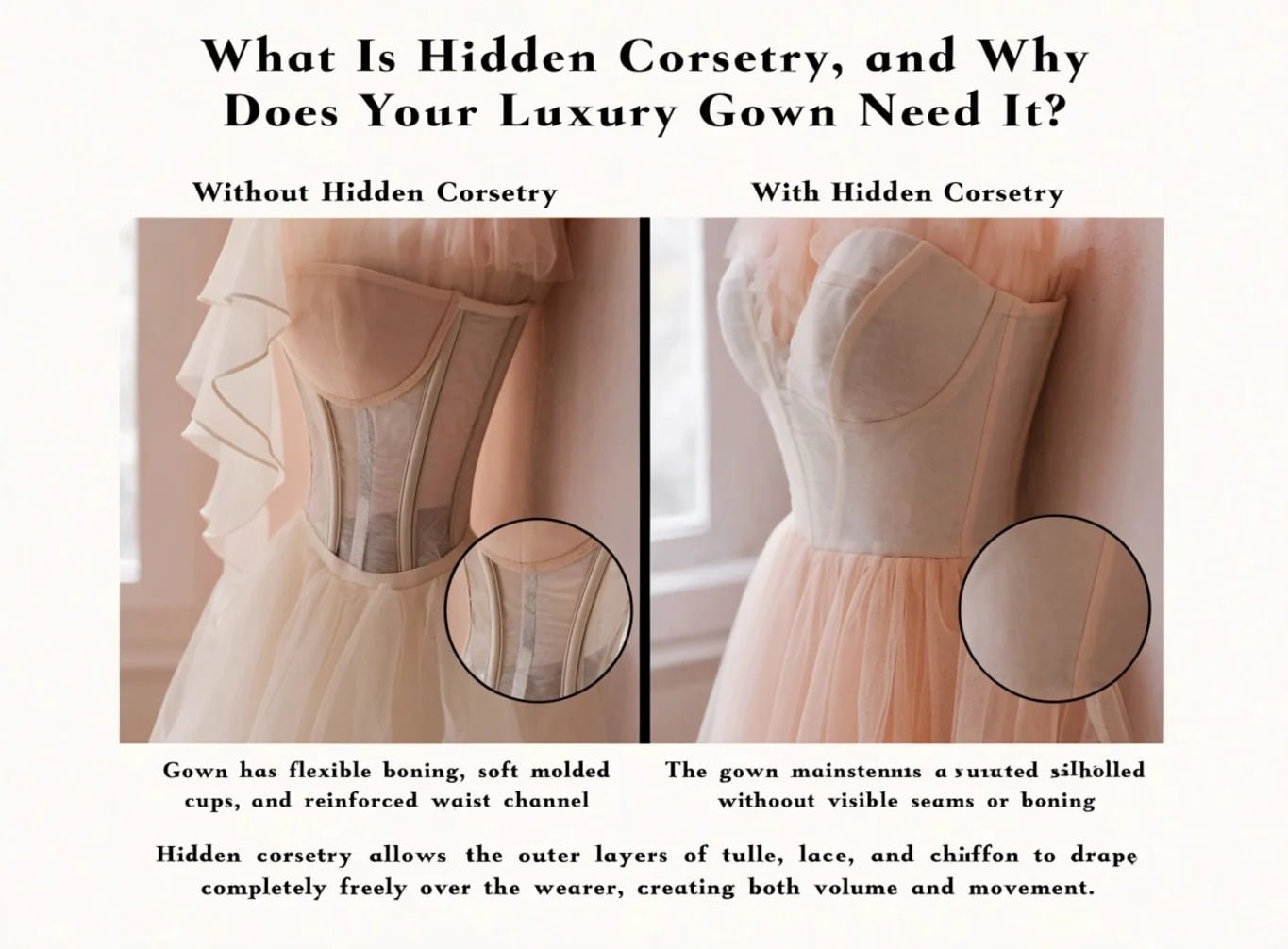
Hidden corsetry is an internal support structure built into the lining of a gown, fully separate from the outer fabric layers. Flexible boning, soft molded cups, and reinforced waist channels hold the dress to the body. The outer layers of tulle, lace, and chiffon then drape completely freely on top — no visible structure, no stiff silhouette, no compromise.
Why Soft-Looking Gowns Still Need a Firm Foundation
The most common concern I hear from indie designers: "I don't want it to look structured." The misunderstanding is that structure means visible structure. It does not.
Think of it this way:
The inner layer does all the physical work — holding the bust, anchoring the waist, preventing the fabric from shifting or dropping. The outer layer does all the visual work — fluid tulle, trailing lace, soft chiffon. Because they do completely different jobs, neither one compromises the other.
A gown with no internal support at all will:
- Drop at the bust within the first hour of wear
- Bunch at the waist and hip as the wearer moves through the evening
- Read flat and inexpensive in photographs
- Make the wearer spend the entire event pulling the dress back into position
I give a firm recommendation on this point with every designer I work with, even when the client initially wants to skip the structure. Every designer who followed this advice has come back with the same reaction: they were glad they listened.
During construction, I film the inside of the gown before the lining is closed. The client sees exactly how the inner foundation is built before it disappears inside the finished dress. This kind of transparency is what ethical wedding dress production in China actually looks like in practice, not just as a phrase on a website. You can read more about how we approach every project and why this level of documentation matters.
What Does the Development Process Look Like, Step by Step?
You send a sketch into the void and wait. Weeks pass. You have no idea what is happening, or if anything is happening at all.
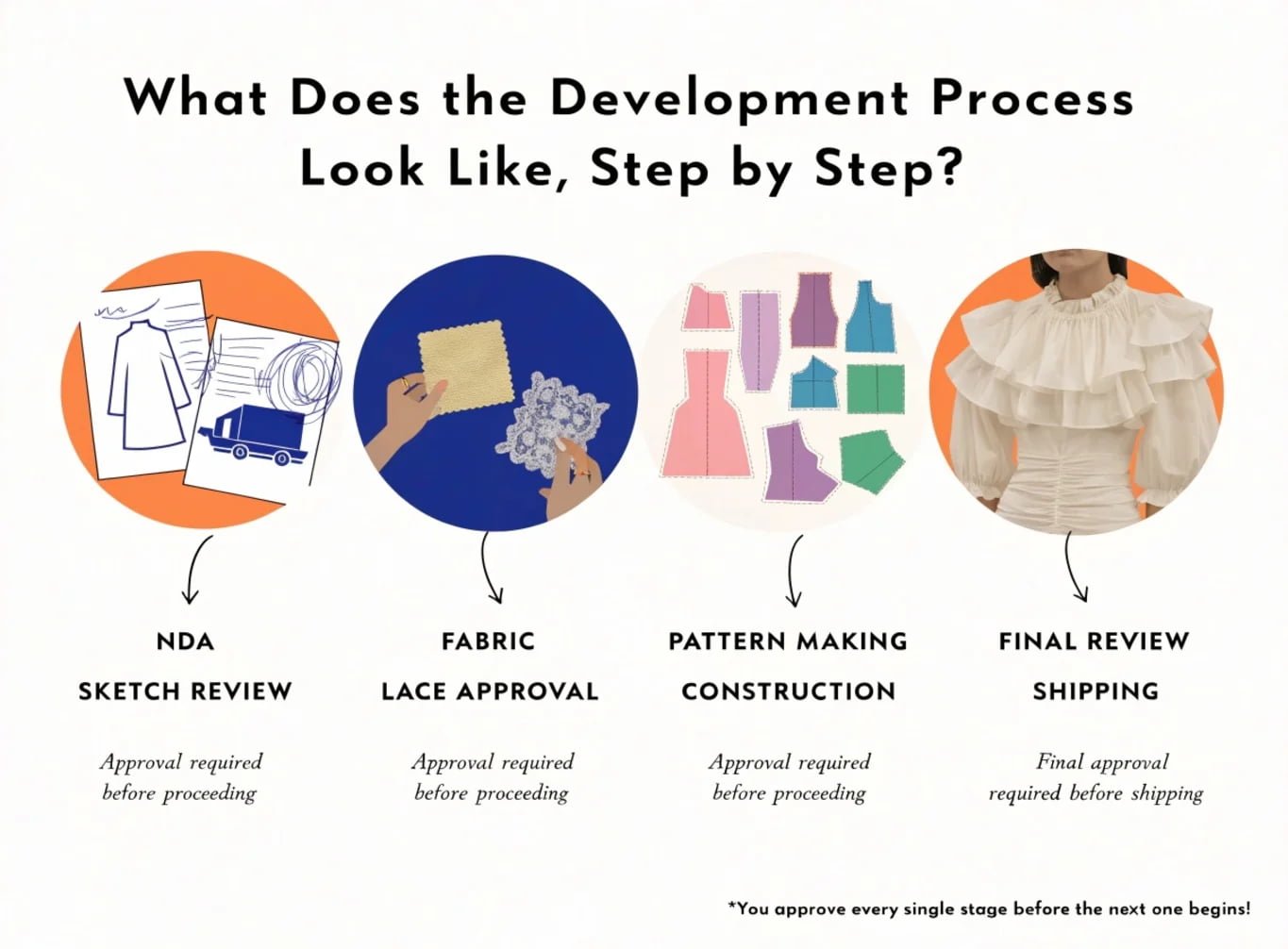
The bespoke process runs in four stages: NDA and sketch review, fabric and lace approval, pattern making and construction, then a final review before shipping. You approve every single stage before the next one starts.
The Four Stages, In Plain Terms
Here is the honest version of our pattern and sampling service, broken into four stages:
| Stage | What Happens | Who Confirms |
|---|---|---|
| 1. NDA & Design Review | You sign, share your sketch or AI concept, we run a technical audit and estimate a sample cost. | You |
| 2. Fabric & Lace Approval | We source real fabric, film it, and send video. Nothing gets cut without a yes. | You |
| 3. Pattern & Construction | We draft the pattern from scratch, build in corsetry, and sew the sample. We message you if anything needs a decision. | Both |
| 4. Final Review & Shipping | You receive photos and video of the finished piece before it ships. | You |
Notice something in that table. You approve at every single stage. We do not cut fabric, add beading, or ship anything without your yes first. That one rule stops most of the bad surprises designers tell me about from other factories.
A Dedicated Tracker Keeps Everything on Record
Every client project also gets a shared tracking document named after their brand. It holds every confirmed decision in one place: fabric codes, lace choices, measurements, structural corrections, and approval records, so nothing gets lost in a WhatsApp thread or buried under an email chain.

If filling in a spreadsheet feels like extra work, just tell me your decisions in a message — I update the tracker on your behalf. The point is one reliable record for both of us, not additional admin for you. Whether you are working with us on a small batch production run or a single bespoke sample, the approval structure is identical. You can see the full breakdown in our development process.
How Much Does It Cost to Develop a Custom Bridal Sample in China?
Nobody publishes real prices. You are left guessing between $200 and $5,000, with no idea which number is honest.
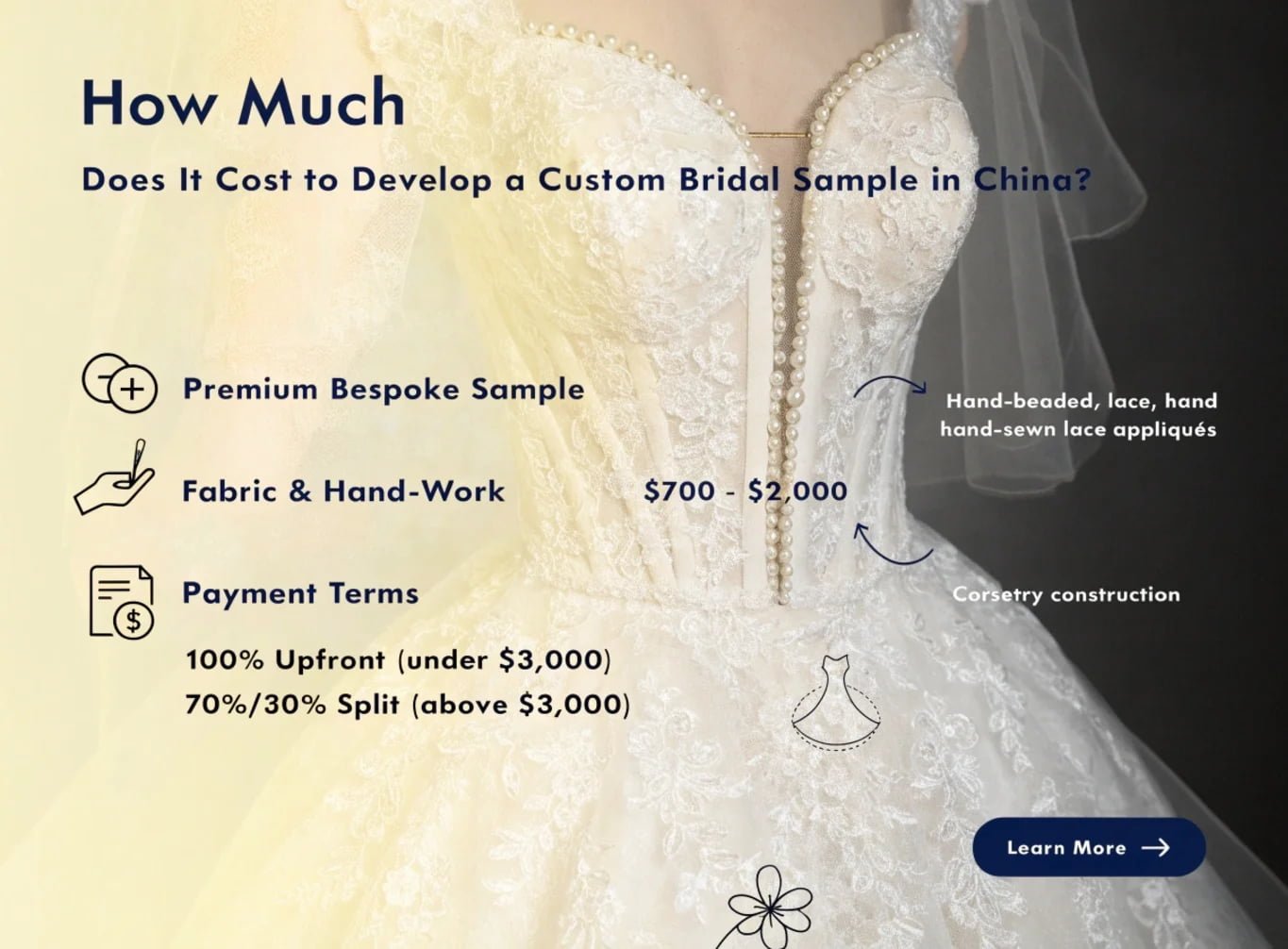
A premium bespoke bridal sample with hand beading, lace, and corsetry construction usually runs $700 to $2,000 per piece, depending on fabric and hand-work. Payment is typically 100% upfront under $3,000, or a 70/30 split above that.
Why the Price Is Not the Same as a Factory Sample
A one-off sample often costs more per piece than a bulk order, and that surprises a lot of first-time designers. Here is why. A bulk order spreads the pattern-making cost across hundreds of dresses. A single sample carries that entire cost alone.
One real quote I gave a client for two premium bespoke pieces, including pattern work, lace, corsetry, and hand beading, came to $750 per piece.
That price included full pattern development, fabric sourcing, and hand-finishing. It did not include a future bulk price, because that number only becomes real once we know exact fabric usage from the finished sample. Any wedding dress factory that quotes you a bulk price before making a single stitch is guessing, or worse, using a number they never plan to honor.
Do I Need a Huge MOQ to Work With a Bridal Manufacturer?
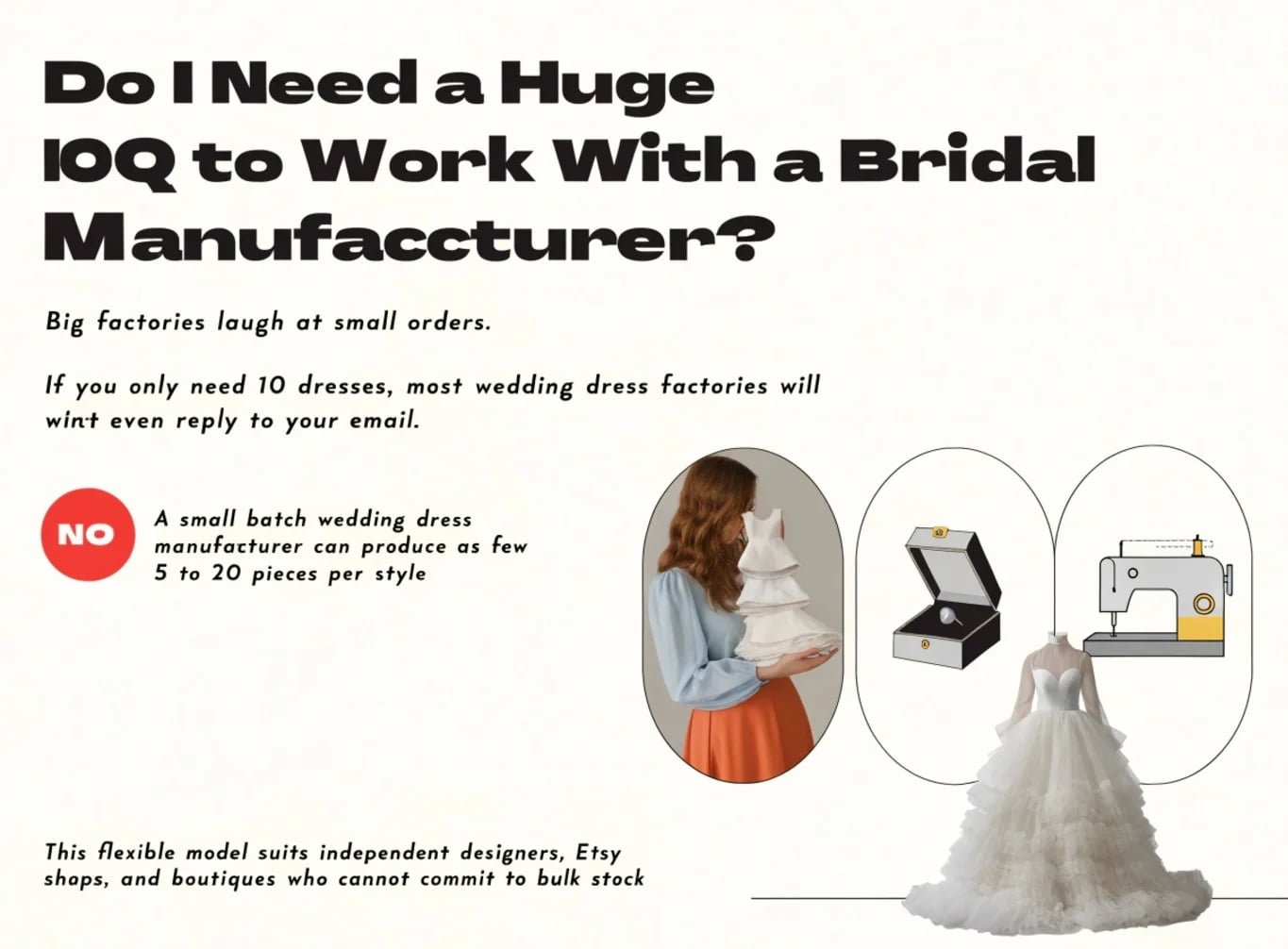
Big factories laugh at small orders. If you only need 10 dresses, most wedding dress factories will not even reply to your email.
No. A small batch wedding dress manufacturer can produce as few as 5 to 20 pieces per style. This flexible model suits independent designers, Etsy shops, and boutiques who cannot commit to bulk stock.
Small Batch Production, Explained
Most large wedding dress factories set a minimum order of 300 to 1,000 pieces per style. That number exists to keep their big machines and big teams profitable, not to help you.
A small batch production model flips that around. A smaller, skilled team can switch between styles without losing money on tiny runs. This same model runs behind private label pieces like:
- Cathedral veils and bridal veils, hand-appliquéd to order
- Detachable sleeves, currently trending
- Heirloom-style toppers, fully custom
You can browse examples in our bridal accessories collection — useful if you need bridal accessories wholesale in small runs, not just full gowns. Whether you need an OEM wedding dress built exactly to your spec, ODM wedding dress development where we help refine the design too, or OEM/ODM bridal accessories like veils and sashes, the entry point stays the same: one sample, no bulk contract attached. This is also what ethical wedding dress production in China actually looks like — transparent costs, no forced volume, no pressure.
How Long Does a Custom Bridal Sample Take in China?
You need the sample by a specific date. A collection launch, a trunk show, or — a real case from my own studio — a bride who was personally wearing the dress she designed to her own wedding in Italy. Deadlines are real. Here is the honest timeline.
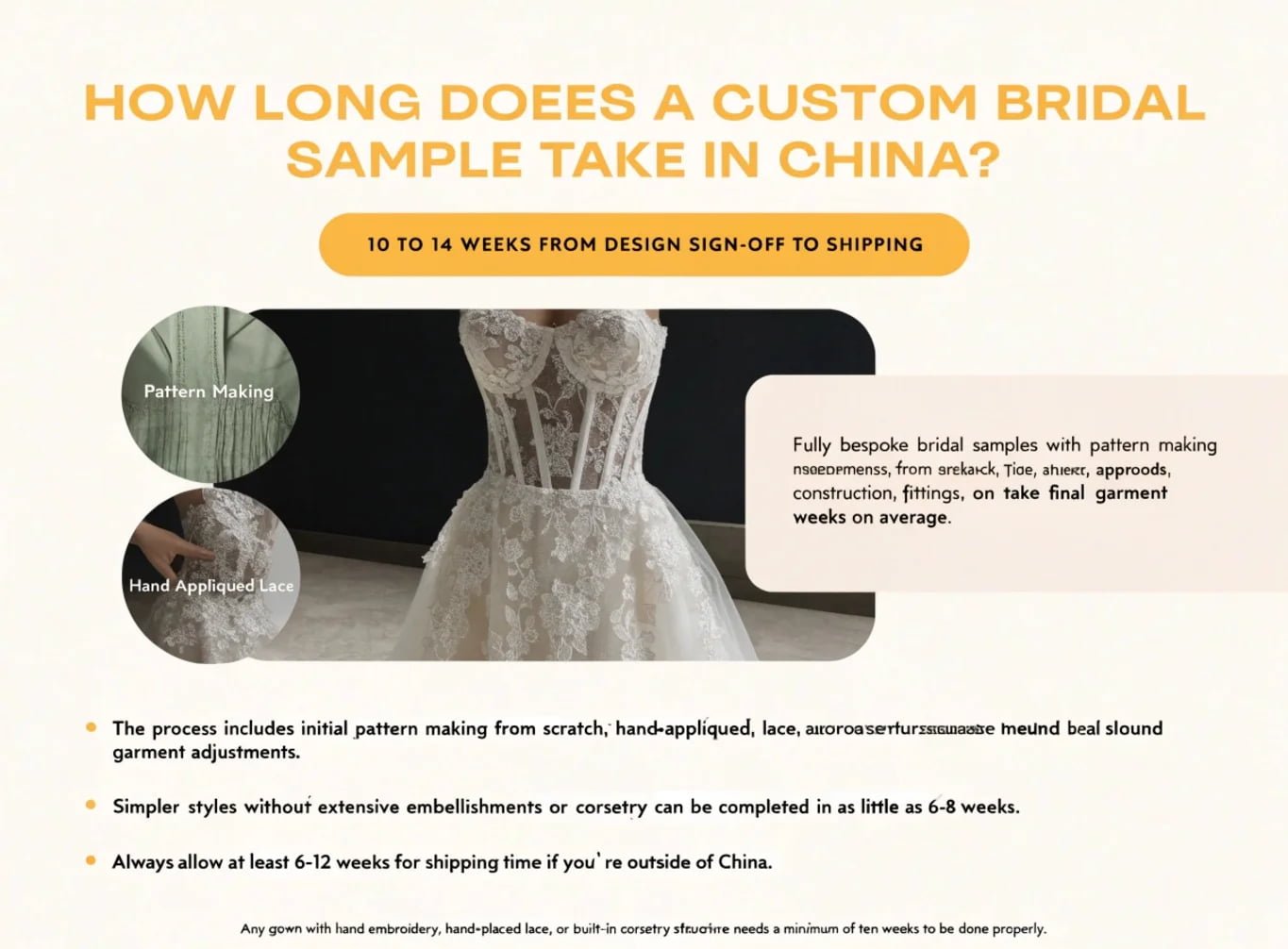
A fully bespoke bridal sample with pattern making from scratch, hand-appliquéd lace, and corsetry construction takes 10 to 14 weeks from design sign-off to shipping. Simpler styles can move faster. Any gown with hand embroidery, hand-placed lace, or a built-in corsetry structure needs a minimum of ten weeks done properly.
A Real Schedule, Based on the UAE Project
| Phase | What Happened | Weeks |
|---|---|---|
| Brief & signing | NDA signed, sketches reviewed, quote issued | 1–2 |
| Fabric & lace approval | Video options sent, client confirmed | 2–4 |
| Pattern drafting | AI corrections resolved, paper pattern built | 4–6 |
| Material procurement | Fabric ordered, color-matching arranged | 6–8 |
| Lace layout review | Layout photographed and sent for client approval | 8–10 |
| Construction | Corsetry, outer fabric layers, hand-finishing | 10–12 |
| Final review | Photos and video sent before shipping | 12–13 |
| DHL shipping | Client confirmed, packed and dispatched | 13–14 |
What makes a timeline realistic versus a red flag:
Any small batch wedding dress manufacturer that promises you a hand-embellished custom sample in under four weeks is either using a pre-existing pattern or skipping approval stages. Real ODM bridal wedding dress development — where the pattern is brand new, the fabric is sourced fresh, and every structural decision is confirmed with you — takes the time it physically requires.
If you have a hard deadline, tell me in the very first conversation. I build the schedule backwards from your target date and plan every phase to hit it. For custom bridal veil private label pieces and simpler accessories from our bridal accessories range, the timeline is significantly shorter. For a fully bespoke gown, ten weeks is the honest floor.
Know your deadline already?
Tell me the date first — I'll build the schedule backwards from it. Request a sample quote → or WhatsApp +8618098949773.
What Happens If the Sample Needs Changes After It's Made?
You get the sample. Something is off. Now what? Do you pay again, or does the factory just disappear on you?
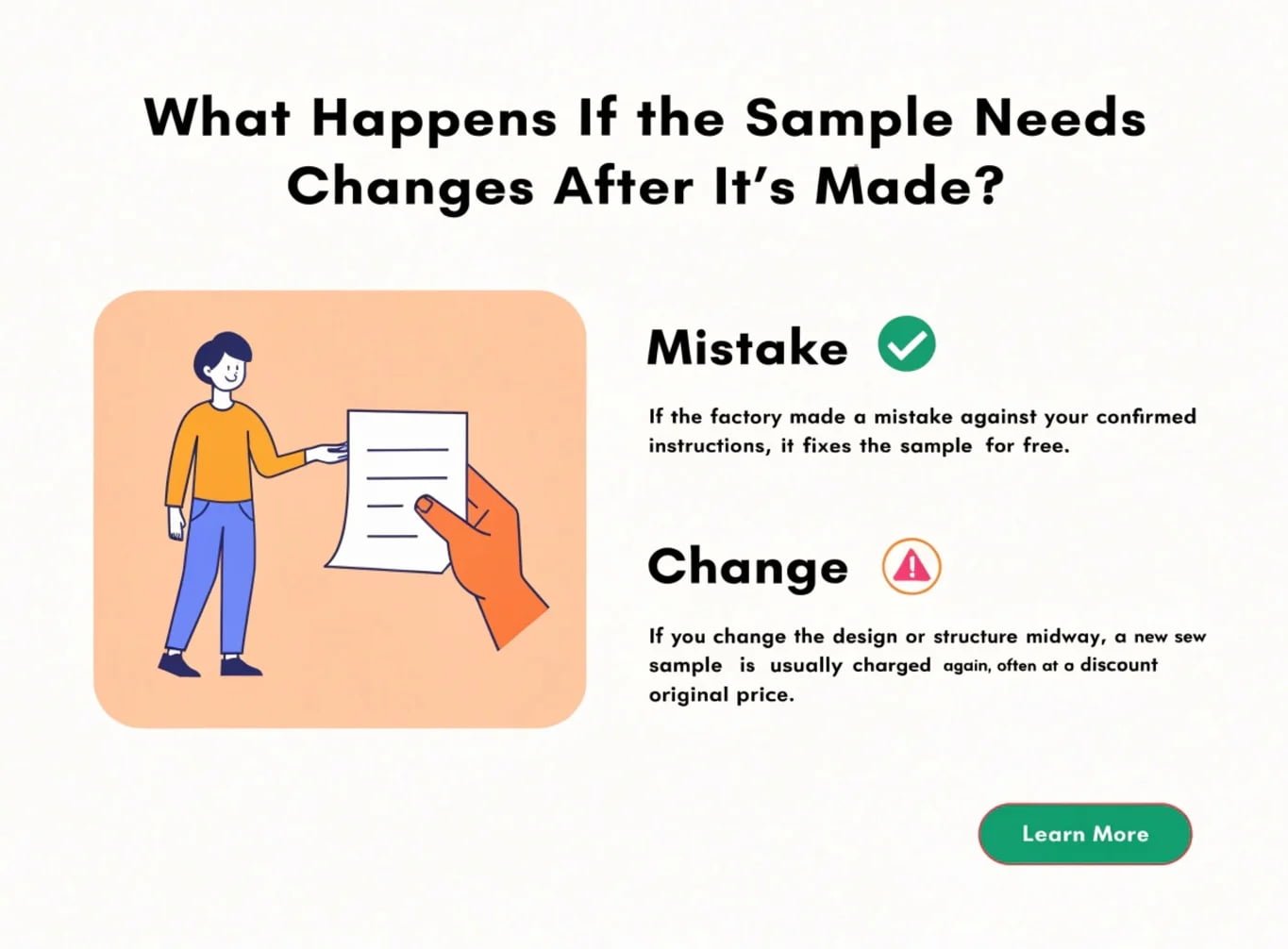
If the factory made a mistake against your confirmed instructions, it fixes the sample for free. If you change the design or structure midway, a new sample is usually charged again, often at a discount off the original price.
Setting the Rule Before You Need It
This rule matters more before something goes wrong than after. I always put it in writing, right on the invoice, before the first stitch is sewn:
If our team deviates from your confirmed specs, we fix it at our cost. If you request a structural or design change midway, a new sample is charged at a 10% discount off the original price. Minor tweaks get judged case by case, often at little or no cost.
Writing this down protects both sides. You know your risk upfront. We know we will not be asked for unlimited free rebuilds every time an idea changes. Any manufacturer promising "unlimited free revisions" with no boundary is either not being honest, or planning to rush your sample and blame you for the result later.
Conclusion
An AI concept, a hand-drawn sketch, or a reference image is enough to start. What turns a sketch into a sample is a manufacturer who treats the technical gap between the two as their job — not yours, who signs your NDA, skips the giant MOQ, and shows you real fabric before cutting anything. That is the whole test.
Ready to Start? Here's How
Your sketch — or your AI concept — is ready. So am I. I sign the NDA first, before I see a single line of your design.
- WhatsApp (fastest): +8618098949773
- Email: kelly@bridalsourcing.com
- Prefer a form? Request a sample quote →
- Follow the process: LinkedIn · Instagram
Not ready to reach out yet? Browse our full collection, read more about our studio, or check out more stories like this on the blog.