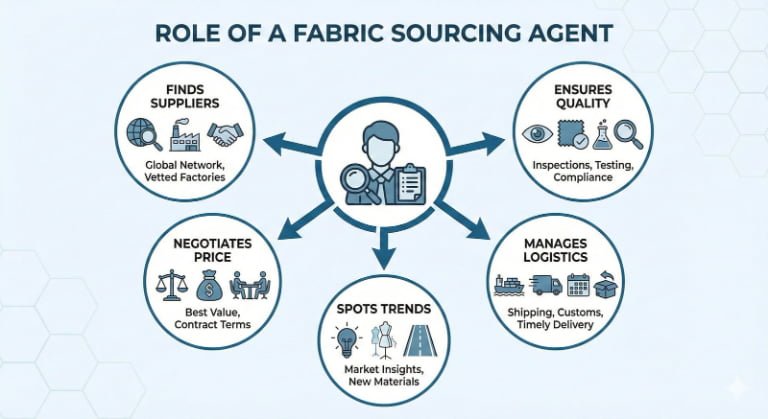
Sarah messaged me from A country with a dream, a list of eight veil styles, and a $24 target price. What happened over the next few months changed how she thinks about building a brand.
Finding the right bridal sourcing partner means more than getting a low price. It means having someone who catches quality traps before they reach your customer — from glued pearls that yellow after six months to lace trim that wastes half the fabric. Sarah's story shows exactly what that looks like in practice, from the first WhatsApp to the factory floor.
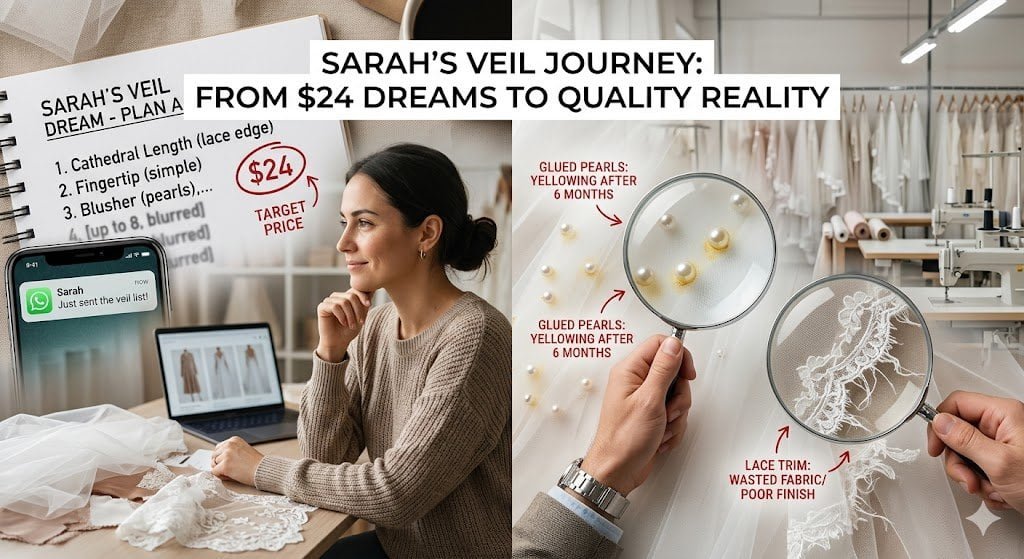
This is a real story. I'm going to walk you through every step — the budget reality check, the materials we sourced together, the sample review in China, and the lessons that came out of it. If you're building a bridal brand right now and wondering whether a sourcing partner is actually worth it, this one's for you.
- How Did a $24 Budget Almost Kill a Premium Veil Collection? 💸
- What Does "Quality" Actually Mean in Bridal Veil Production? 🔍
- 💡 Ready to Check Your Own Veil Quality Standard?
- How Do You Choose the Right Lace for a Cathedral Veil? 🧵
- Why Did Sarah's First Sample Review Change Everything? 🏭
- What Can Indie Designers Learn from Premium Bridal Supply Chain? 🏆
- 🎯 Ready to Start Your Own Story?
- Conclusion
- About Me 👋
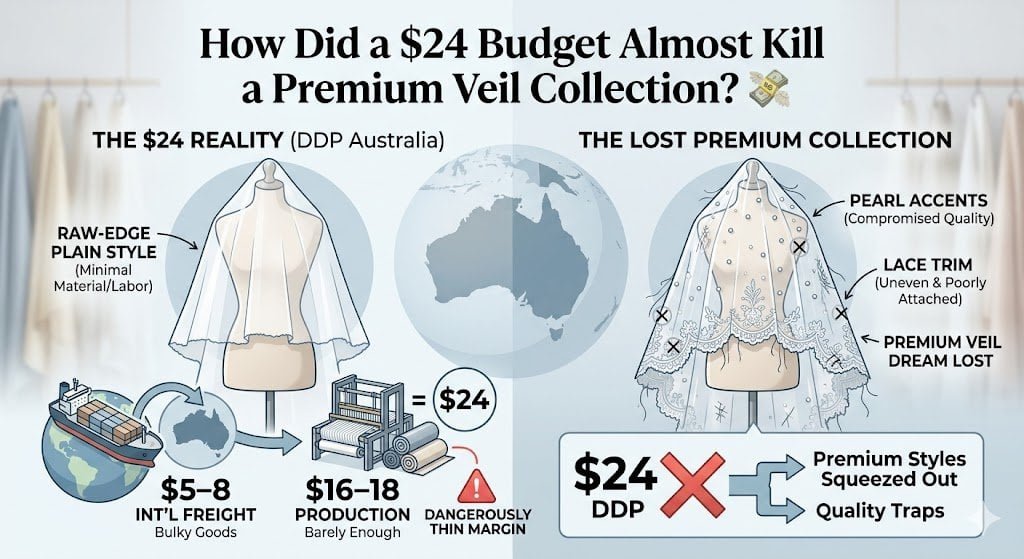
Sarah wanted the best quality at the lowest price. Every designer does. The problem is that $24 including DDP shipping to Australia doesn't leave much room to work with.
A $24 DDP target price for a cathedral veil sounds reasonable until you subtract international freight ($5–8 per piece for bulky goods shipped to Australia). That leaves $16–18 for production — barely enough for raw-edge plain styles, and dangerously thin for pearl or lace styles without compromising quality.
The Math Nobody Tells You 🔢
Here's the breakdown I ran for Sarah on day one:
| Veil Style | DDP Target | Estimated Freight | Production Budget Left | Verdict |
|---|---|---|---|---|
| Raw Edge Cathedral | $24 | ~$6 | ~$18 | ✅ Possible |
| Shimmer Cathedral | $24 | ~$6 | ~$18 | ✅ Possible |
| Pearl Cathedral | $24 | ~$6 | ~$18 | ⚠️ Risky |
| Lace Edge Cathedral | $24 | ~$6 | ~$18 | ⚠️ Risky |
| All-Lace Veil | $24 | ~$6 | ~$18 | ❌ Very Difficult |
The raw-edge and shimmer styles? Completely doable. Those are the "green light" items. But pearl and lace styles at $18 production cost? That's where things get dangerous — not because it's impossible, but because of what factories will do to hit that number.
The Glued Pearl Trap 😬
At $18 production budget, factories use glued pearls. I've seen this a hundred times. The glue yellows after six months in storage. The pearls fall off. And your bride is standing at the altar with a disintegrating veil.
The machine-fixed version — where each pearl is mechanically riveted through the tulle — costs more. But it's the only option worth putting your brand name on.
Kimmy's Rule: For only $8 more per piece on the premium option, the perceived value to your customer jumps by $50–100 at retail. That's not an upsell. That's just math.
Sarah understood this immediately. We moved forward with a two-tier approach: budget-friendly specs for the plain styles, and a small premium for the pearl and lace ones. Her collection stayed intact. Her margins stayed healthy.
What Does "Quality" Actually Mean in Bridal Veil Production? 🔍
The word "quality" gets thrown around constantly in bridal. But when you're sourcing from China, it has a very specific technical meaning — and most first-time designers don't know what to look for.
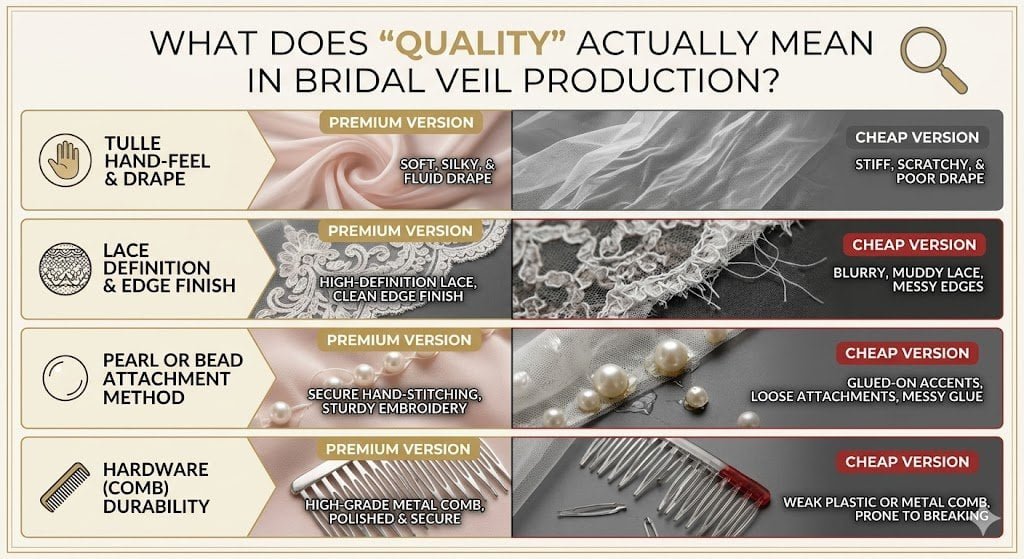
Bridal veil quality breaks down into four checkpoints: tulle hand-feel and drape, lace definition and edge finish, pearl or bead attachment method, and hardware (comb) durability. Each checkpoint has a cheap version and a premium version — and the difference is often invisible until it's too late.
✅ Checkpoint 1: Tulle — Soft Illusion vs. Stiff Nylon
Hold a piece of standard nylon mesh and it feels like a mosquito net. It's shiny. It's crunchy. It holds every wrinkle from shipping.
Now hold a piece of Soft Illusion Tulle. It drapes like water. It's matte. It moves with the bride instead of fighting her. The difference is immediate and unmistakable — but only if you know what you're holding.
For Sarah's collection, we specified Soft Illusion Tulle for all flowing styles. The slightly stiffer mesh was reserved only for two-tier styles where structural volume was intentional.
✅ Checkpoint 2: Pearls — Glued vs. Machine-Fixed
- ❌ Glued pearls: Applied with adhesive. Yellows over time. Falls off under heat or humidity. Looks plasticky up close.
- ✅ Machine-fixed pearls: Mechanically riveted through the tulle. Clean back. Secure for years. Photographs beautifully.
There is no middle ground here. If a factory offers you pearls at a price that seems too good, they are glued. Full stop.
✅ Checkpoint 3: Combs — The Detail That Kills Brands Slowly 🪮
Here's something I learned the hard way through years of working with major bridal clients: metal combs yellow and rust. One of the most consistent complaints I've seen from major US bridal brands was brides finding their combs discolored after storage.
My solution — and the standard I hold for every client — is a metal comb with a special anti-oxidation coating, wrapped in white fabric. This comb grips the hair firmly, looks luxurious, and I can guarantee it won't change color within one year of normal use. Most factories don't do this. Most designers don't know to ask for it.
✅ Checkpoint 4: Lace — Definition vs. Fuzz
Mass-market lace has fuzzy edges. The pattern looks blurry. The threads pull. It goes limp after one wash.
High-definition bridal lace has corded edges — a fine cord runs along the perimeter of every motif, giving it a crisp, 3D definition that photographs stunningly and holds its shape over time.
"The details your customer never notices when they're right, and can never forgive when they're wrong." — This is the standard I work to, every single time.
💡 Ready to Check Your Own Veil Quality Standard?
If you're currently sourcing bridal veils — or planning to — and you're not sure whether your supplier is hitting all four checkpoints, let's talk.
📧 Email: kimmy@bridalsourcing.com
📱 WhatsApp: +86 181 2218 7212
🌐 Browse our lace and fabric collections: bridalsourcing.com/collection/premium-lace
How Do You Choose the Right Lace for a Cathedral Veil? 🧵
This is the question that trips up almost every first-time designer. Cathedral veils and lace are a beautiful combination — but the cost math behind them is brutal if you don't understand it upfront.
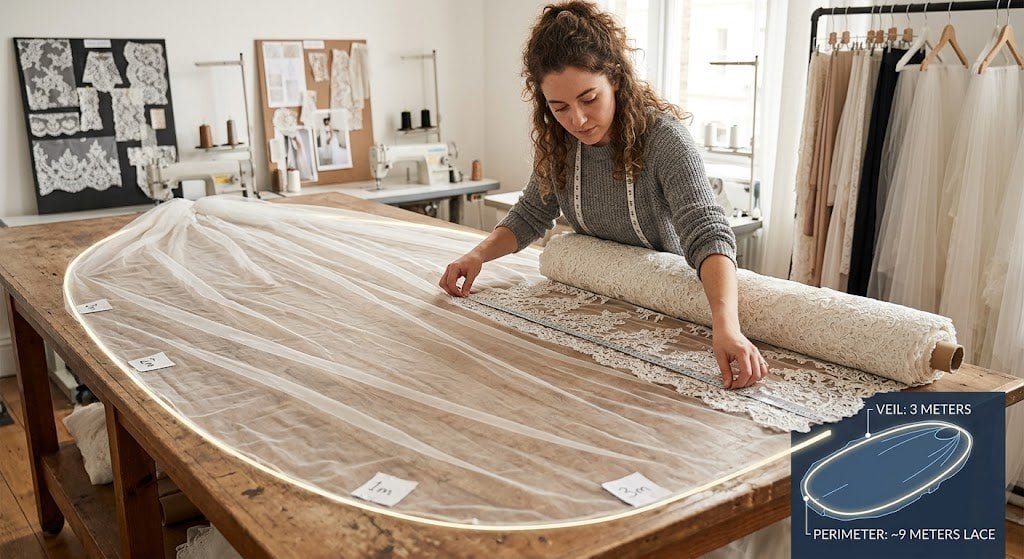
A 3-meter cathedral veil requires approximately 8–9 meters of lace trim around its full perimeter. This means lace width and complexity multiply directly across the entire edge, making fabric selection the single biggest cost lever in lace veil production.
The Perimeter Problem Nobody Explains 📐
Most designers think of fabric in linear meters. A 3-meter veil = 3 meters of lace. Wrong.
A cathedral veil is roughly elliptical. When you trace the full edge — including both sides and the gather at the top — you're looking at 8–9 meters of trimming per veil. If your lace is 10cm wide and costs $3 per meter, that's $24–27 in lace trim alone. Before the tulle. Before the comb. Before labor.
This is why I always ask designers: How wide is the lace you're imagining? The answer determines everything.
The Lace Options We Sourced for Sarah 🪡
Here's a real breakdown of the lace sourcing work we did together:
For Style #A (Lace-Edge Cathedral):
| Option | Code | vs. Original | Notes |
|---|---|---|---|
| Original Selection | CR1313C | — | Beautiful but higher MOQ risk |
| Similar Quality Upgrade | CRC1511C | ~5% more | Comparable feel, better availability |
| Budget-Friendly Alternative | #834 | ~10% less | Clean corded edge, easier to sew |
| Best Value Pick | #834-1 | ~10% less | Corded wave edge — my recommendation |
For Styles #B & #C (Mantilla + Two-Tier Lace):
| Option | Code | Price vs. Original |
|---|---|---|
| Original | CRL283EC | — |
| Alternative A | CRL142E | Similar |
| Alternative B | CRL165EC | Similar |
| Alternative C | #834-1 | Slightly lower |
The Fabric Waste Problem 🚫
Here's a sourcing insight that saved Sarah real money. For one of her styles, the original plan was to cut the scalloped edge from a full lace panel (CR1511C-3). On paper, this seems fine. In practice, cutting just the edge from a full-width lace panel wastes the entire center section of the fabric.
My technical team caught this. We switched that style to the dedicated scalloped edge trim #834-1 — a pre-made corded wave edge that uses exactly what you need and nothing more.
Result: Cost dropped significantly on that style. No fabric waste. Cleaner production line.
This is the kind of detail that only comes from having people on the factory floor who are thinking about your margins, not just filling your order.
Lace Style Reference Guide 📖
| Lace Type | Best For | MOQ Risk | Notes |
|---|---|---|---|
| Chantilly | Mantilla, Romantic styles | Medium | Delicate, needs eyelash fringe finish |
| Corded Scallop | Cathedral edge, Two-tier | Low | Clean, structured, most versatile |
| Eyelash Fringe | Mantilla, Soft edge | Medium | Romantic, pairs well with Chantilly |
| 3D Floral Appliqué | Statement veils | High | Higher labor, requires skilled hands |
| #835-1 Wave Edge | Budget-conscious lace styles | Low | Our go-to for value without compromise |
👉 Want to see the actual lace options we work with? Browse our premium lace collection here →
Why Did Sarah's First Sample Review Change Everything? 🏭
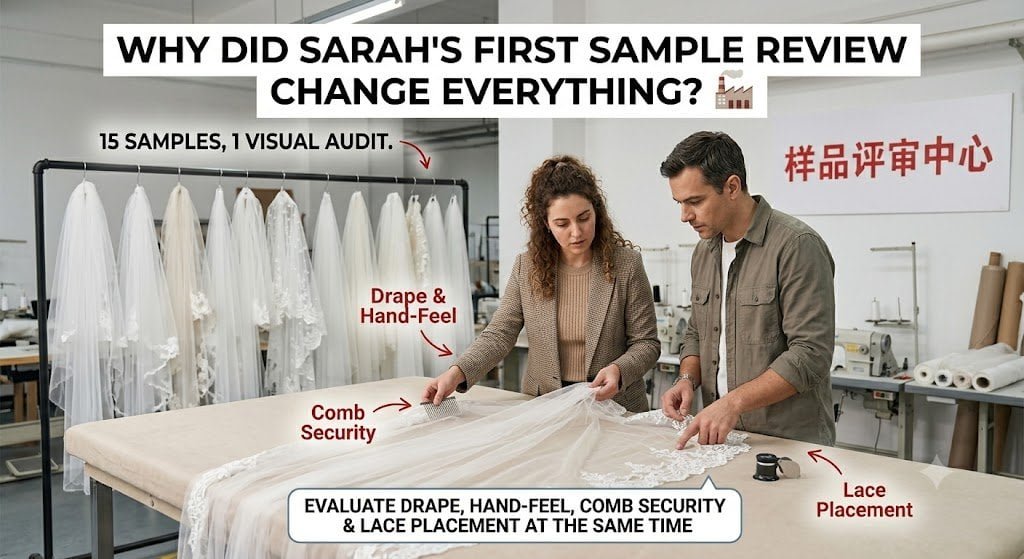
Sarah flew to China in May. We walked through 15 samples together on the factory floor. That visit taught both of us things you simply cannot learn from photos or video calls.
An in-person sample review at the factory lets a designer evaluate drape, hand-feel, comb security, and lace placement at the same time — details that photos cannot fully capture. For Sarah, this visit confirmed which styles to keep, which to drop, and exactly how to refine the production standard for bulk orders.
The Mantilla Comb Lesson 🪮
This is one of my favorite examples of why in-person review matters.
One of Sarah's mantilla-style veils arrived with the comb slightly off-center. The lace motif was perfectly centered. The comb was not. When worn, one side of the veil draped longer than the other.
The correct method for attaching a mantilla comb:
- Fold the veil exactly in half — finding the true geometric center
- Mark the center point — not by eye, but by measurement
- Attach the comb at that exact point — so both sides hang symmetrically when worn
This sounds obvious. It isn't. Many factories eyeball it. And when a bride puts on a mantilla veil that's off-center, she feels it before she sees it.
I caught this during the review. I updated the master sample in the factory immediately. Sarah's client veils will be correct. I also noted this in our Development Tracker so the correction is documented for every future bulk order.
What We Confirmed and What We Dropped 📋
After the full review of 15 styles, Sarah confirmed Styles #A, #D, #E, #F, and #G for development. The remaining styles were dropped from the active collection — but I still sent her one piece of each dropped style. She wanted them for data, records, and future reference. That's smart brand management.
We document everything in a Development Tracker — a single Excel file that serves as the living record of every style: fabric specs, lace codes, comb type, development comments, invoice numbers, and revision history. Every change gets logged. Nothing gets lost.
"I am very glad I asked this question, because it helped me better understand the level of risk involved on your side of the business." — Sarah, after we walked through the full pricing structure together.
The 150 RMB Transparency Moment 💬
After the factory visit, I sent Sarah an invoice averaging 150 RMB per piece across all 15 samples. She asked why the quantity changed from her original invoice.
I explained it directly: we physically made 30 pieces — one set for her, one factory reference set. The invoice reflected 30 pieces, but I only charged her for the 15 pieces she received. The factory reference copies, I absorbed on my end.
She appreciated the transparency. I appreciated that she asked. That kind of open communication is exactly what makes a long-term partnership work.
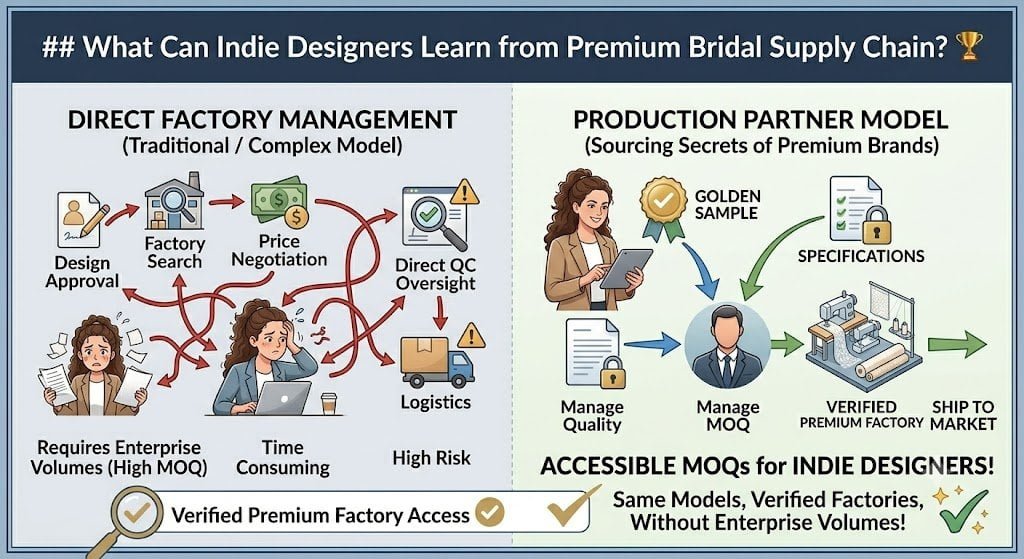
I've spent over 20 years in the bridal supply chain. Some of my clients are household names. The way they manage sourcing is surprisingly simple — and completely accessible to independent designers.
Premium bridal brands like use a Production Partner model rather than direct factory management. They approve a golden sample, lock in specifications, and let their supply chain partner manage quality, MOQ, and logistics. Independent designers can access the exact same model — and the same verified factories — without needing enterprise-level order volumes.
Two Models — One Clear Winner for Indie Brands 🥊
| Model A: Direct Agent | Model B: Production Partner | |
|---|---|---|
| How it works | You pay monthly salary, contact factories directly | I manage everything, provide consolidated final price |
| Factory relationship | You vs. the factory | My leverage + your order |
| MOQ risk | All yours | I absorb and manage |
| Quality control | Self-managed | My team inspects before shipping |
| Small order treatment | Often ignored or deprioritized | Protected by my combined volume |
| Best for | Large brands with in-house sourcing teams | Indie designers and startup brands |
Why does direct factory contact fail for small brands?
Factories in China are realistic. If a new brand approaches them with 20 pieces, they will often delay the order, use leftover fabric, or skip QC steps. You don't have leverage. You're not their priority customer.
When I place your order, I place it alongside other orders I'm managing. The factory sees my total volume. Your 20 pieces get treated like part of a much larger order. That's the leverage I bring to your brand.
The Innovation Fund Model 💡
For Sarah, we structured the engagement around an Innovation Fund deposit — $600 USD. This wasn't a fee that disappeared. It stayed in her account as a standing foundation for the partnership.
What this unlocked:
- ✅ Unlimited sample development — no new deposit per style
- ✅ Continuous testing of new designs for market validation
- ✅ Bulk orders billed at actual production quantity (no forced minimums)
- ✅ Price locking after sample confirmation
- ✅ Full BOM transparency: supplier name, fabric code, unit price, consumption
The only time a locked price ever changes is a genuine force majeure event — a global crisis that drives raw material costs up industry-wide. Even then, nothing moves without our mutual agreement.
This is how Vera Wang works with their production partners. It's how David's Bridal works. And it's exactly how Sarah works with us now.
The Development Tracker: Your Single Source of Truth 📊
Every style, every revision, every invoice number — all in one living document. Sarah even added an "Invoice Number" column herself so she could track which samples fell under which invoice. That's exactly the kind of systematic thinking that builds a brand that scales.
"I truly enjoy working with you too. Adding an Invoice Number column is a brilliant idea — go right ahead. This is exactly what the Development Tracker is built for."
You can see our full process here → or explore our services → to understand how the Production Partner model works in practice.
🎯 Ready to Start Your Own Story?
Sarah started with a WhatsApp message. You can too.
Whether you have a fully developed brief or just a mood board and a dream, I can help you figure out exactly what's possible — at your budget, at your scale, without the MOQ pressure.
Here's what we can do together:
- 🪡 Fabric & Lace Sourcing — find the exact tulle and lace your collection needs
- 📐 Pattern & Sampling — turn your sketches into physical samples
- 📦 Small Batch Production — starting from as low as 10–20 pieces per style
- 🛍️ Browse our fabric collections — see the actual materials we work with
💌 Let's Talk About Your Collection
I reply within 24 hours. No commitment required.
📧 Email: kimmy@bridalsourcing.com
📱 WhatsApp: +86 181 2218 7212
🌐 Website: bridalsourcing.com
Conclusion
Sarah started with a WhatsApp and a dream. She now has confirmed styles, locked pricing, and a supply chain partner who treats her indie brand with the same standard as the biggest names in bridal. That's what finding the right partner actually looks like.
About Me 👋
I'm Kimmy, founder of Bridal Sourcing — a sourcing and production studio based in Shenzhen and Guangzhou, China. I've spent 20+ years in the bridal supply chain, working with clients from David's Bridal to Vera Wang, and now I help independent designers and boutique brands build their collections without the headaches of high MOQs, quality surprises, or communication breakdowns.
I act as your eyes and ears in China — from the first fabric swatch to the final QC inspection before your samples ship.
📞 Connect With Me
Email: kimmy@bridalsourcing.com
WhatsApp: +86 180 9894 9773
LinkedIn: linkedin.com/in/bridalsourcing
Instagram: @bridal_sourcing
💌 Want to build your veil collection with the same process Sarah used?
Send me a message today → and let's talk about what's possible for your brand.